Most landlords assume that if a rental has a heater in the lounge, the heating box is ticked. It is not that simple. The Healthy Homes heating standard is far more specific than “provide some heating,” and plenty of properties that feel perfectly warm still fail it on paper. With the compliance deadline now passed and penalties of up to $7,200 per breach on the table, it is worth knowing exactly what the standard asks for.
Here is what the heating standard actually requires, the part landlords most often miss, what does and does not qualify, and how to get a rental over the line without overspending.
Your rental must have a fixed heating device in the main living room that can heat that room to at least 18 degrees Celsius, and that device must meet the minimum heating capacity calculated for the room. Portable heaters and unflued gas heaters do not count. For most Auckland living rooms, a correctly sized heat pump is the simplest way to meet the standard.
That is the whole thing in two sentences. The detail is where landlords trip up.
The heating standard sits inside the wider Healthy Homes Standards, which cover five areas: heating, insulation, ventilation, moisture and drainage, and draught stopping. Heating is the one that catches the most people out.
The standard says the main living room, the largest room the tenant uses day to day, needs a fixed heater that can warm it to 18 degrees on a cold day. Two words in that sentence do the heavy lifting. Fixed, meaning plumbed or wired in place, not something a tenant plugs in and moves around. And capable, meaning it has to be powerful enough for that specific room, not just present.
This is where good intentions fail an inspection. A heater that keeps the room comfortable on a mild evening can still fall short of the required capacity for that room’s size, insulation and glazing. The standard is tied to a calculated heating capacity, worked out with the official heating assessment tool, and the heater has to meet or beat that number.
Auckland has a lot of large, open-plan living rooms and high-stud villas where the required capacity climbs quickly. A small plug-in panel heater that satisfies a tiny bedroom sized space will not meet the number for a five by four metre lounge with big windows. The same room size logic sits behind our heat pump size calculator, which is a quick way to see roughly how much heating a living room actually needs before you commit to anything.
Here is the quick sort, because the “does not count” column surprises people.
| Qualifies (if it meets the capacity) | Does not qualify |
| A fixed heat pump | Portable electric heaters (plug-in, movable) |
| A flued gas heater | Unflued gas heaters |
| A wood burner or pellet burner | Open fires |
| A fixed electric heater that meets the capacity number | Most existing small fixed heaters that fall under the required capacity |
The two that catch landlords most often are the portable electric heater in the corner, which is never compliant because it is not fixed, and the unflued gas heater, which is specifically excluded because of the moisture and safety issues it creates in a rental.
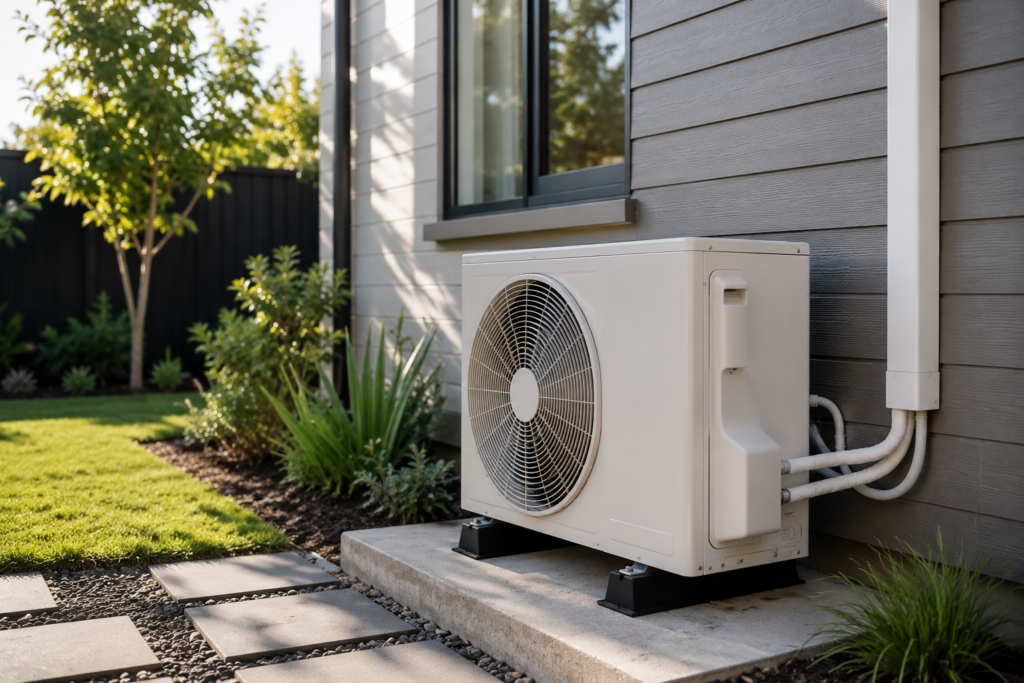
You do not have to install a heat pump. But for most Auckland living rooms it is the path of least resistance, and here is why. It comfortably meets the capacity number for a typical lounge, it is fixed and permanent so it satisfies that requirement automatically, it costs little to run so tenants actually use it, and it cools the room in summer as a bonus. Tenants are familiar with them and rarely complain, which quietly reduces your maintenance calls.
It is also a fast, tidy install. A single unit usually goes in within a few hours, and once it is in, the heating box is genuinely ticked rather than technically argued.
One thing to budget for: older Auckland rentals, particularly villas and 1970s homes, often have switchboards that were never built for a modern heat pump. Meeting the standard sometimes means an electrical upgrade alongside the install, which is exactly the kind of surprise that derails a DIY approach. Because we handle the electrical work in-house as part of the installation, there is no chasing a separate electrician or coordinating two trades around a tenancy.
Worth clearing up, because landlords ask constantly. The Warmer Kiwi Homes grant does not apply to rentals. As we explain in our guide to heat pump grants in New Zealand, that funding is for owner-occupiers only, so as a landlord you are funding compliance yourself. The upside is that a compliant heat pump is a genuine improvement to the property, not just a cost, and it is deductible as a rental expense. Compliance work across all five standards can run from around $1,000 for minor jobs to well over $20,000 for a property that needs the lot, so the heating piece is usually one of the more affordable and highest-value parts.
A common landlord worry, and the answer is reassuring. The heating standard applies to the main living room only. You are not required to put a fixed heater in every bedroom or hallway to comply, so the cost is usually a single, correctly sized unit in the room that matters rather than a whole-home system. That said, the other four standards still apply across the property, and you will need to include a Healthy Homes compliance statement in most new or renewed tenancy agreements, confirming the property meets all five. Getting the living room heating right is the anchor, and it is often the one piece that needs real installation work rather than paperwork, which is why it pays to sort it properly the first time.
Three steps. Get the main living room assessed so you know the required capacity and whether your current heater meets it. Fix any gap with a compliant, correctly sized fixed heater before the next tenancy begins. And keep the documentation, because a professional assessment becomes your compliance record if a tenant ever disputes it. With penalties reaching $7,200 per breach, the paperwork is worth as much as the heater.
The heating standard is very beatable, but only if the heater is fixed, compliant and correctly sized for the room. Guessing is where landlords get caught.
Varcoe has been heating Auckland homes since 1975, and we install, wire and assess all in-house, so a rental can go from non-compliant to sorted in a single visit. See how our Healthy Homes compliance service for landlords works, or book a free healthy home assessment and we will tell you exactly what your property needs and what it will cost. No pressure, no obligation. Call us on 0800 088 888 or email info@varcoe.co.nz.
A fixed heating device in the main living room that can heat it to at least 18 degrees Celsius and meets the minimum heating capacity calculated for that room. Portable heaters and unflued gas heaters do not qualify.
Yes, provided it is sized to meet the required heating capacity for the living room. A correctly sized heat pump is the most common and cost-effective way Auckland landlords meet the standard.
No. The standard requires a fixed heater, so a plug-in portable heater never qualifies no matter how powerful it is.
It depends on the room’s size, insulation and windows, worked out with the official heating capacity calculation. A large or open-plan Auckland lounge needs noticeably more capacity than a small room, which is why a quick sizing check matters before you buy.
Landlords can face penalties of up to $7,200 per breach, and tenants in a non-compliant property have grounds to require the landlord to fix it.
No. Warmer Kiwi Homes is for owner-occupiers only. Landlords fund compliance themselves, though the work is a deductible rental expense.
We assess, size and install compliant heating in-house, so it is done in one visit.