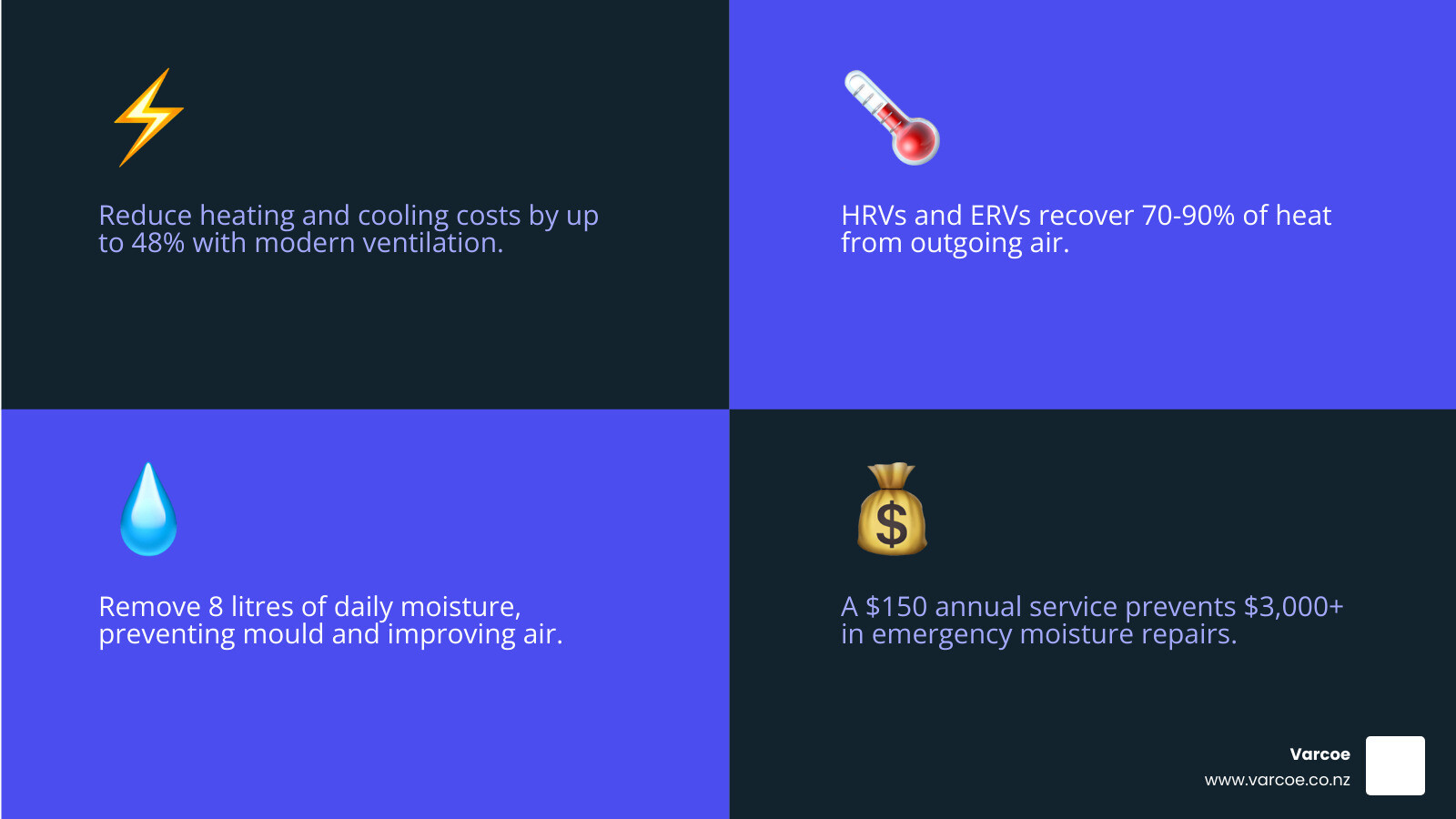
If you’re waking up to condensation streaming down your windows, noticing musty odours in your Grey Lynn bungalow, or watching your power bills climb while your home still feels stuffy, you’re not alone. A typical Auckland family produces around 8 litres of moisture daily just from cooking, showering, and breathing. Without proper ventilation, that moisture gets trapped in your walls, windows, and lungs.
Modern airtight homes in areas like Flat Bush and Hobsonville are great for saving on heating, but they trap pollutants inside, often leading to mould within years. The hidden cost of fixing this moisture damage can easily top $3,000, covering mould remediation and structural repairs.
This is where energy efficient ventilation comes in. It’s the process of continuously replacing stale, polluted indoor air with fresh outdoor air while recovering up to 90% of your heating energy. For Auckland homeowners, this means healthier air, a drier home, and dramatically lower power bills. A simple $150 annual service can prevent thousands in damage, while a professionally installed system pays for itself in energy savings.
Your home needs to breathe. Without it, the air becomes a stagnant mix of moisture and pollutants that can damage your property and your family’s health. In Auckland’s humid climate, understanding ventilation is key to protecting your biggest investment.
Your home is constantly sending signals that its ‘lungs’ are struggling. After 50 years of visiting Auckland homes, we see the same issues from Ponsonby to Papakura. Ignoring them can lead to expensive, preventable repairs.
These problems are solvable. A properly designed energy efficient ventilation system removes the excess moisture and pollutants causing these issues, protecting both your family’s health and your home’s structure.
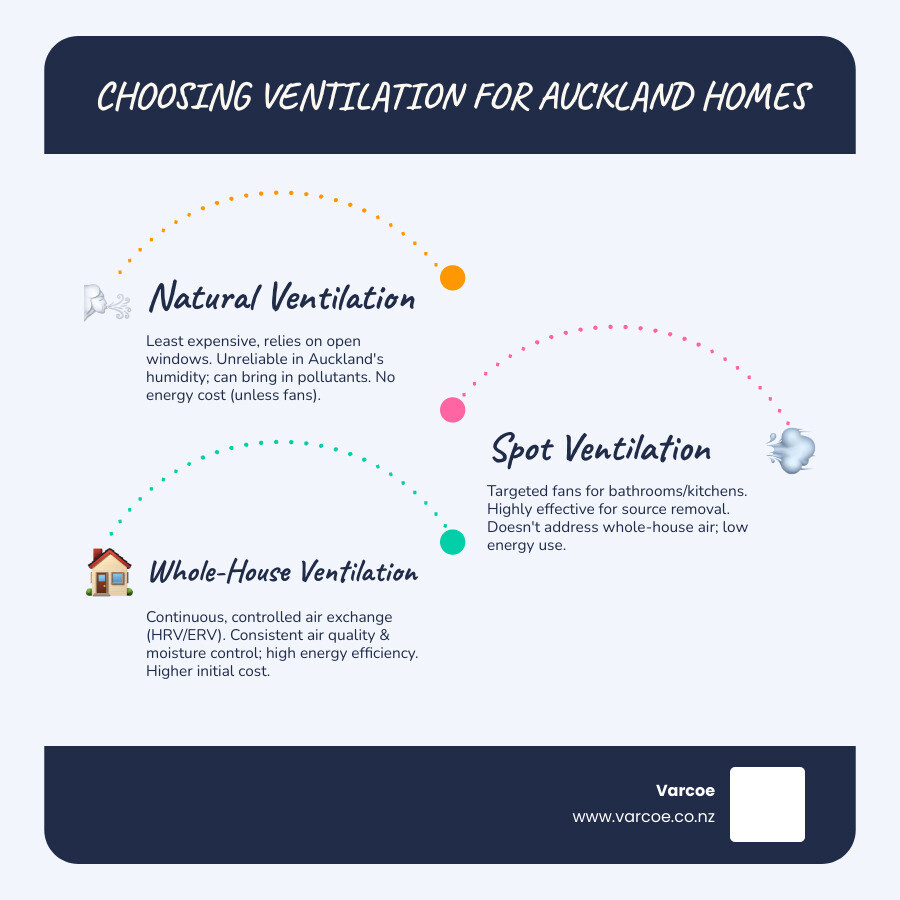
There’s no one-size-fits-all solution. A draughty Mt Eden villa needs a different approach than an airtight Millwater home. Here’s a quick guide:
Natural Ventilation (Opening Windows): It’s free and feels great on a dry, breezy day. However, in Auckland’s humidity, it can let more moisture in. It’s also insecure, noisy, and lets in dust and pollen. It’s simply not a reliable, year-round solution.
Spot Ventilation (Exhaust Fans): These are your bathroom and kitchen fans. They are essential for removing moisture and odours at the source. For a bathroom, you need a fan that moves at least 25 litres per second (L/s), and it must vent directly outside, not into your ceiling space, as required by the MBIE Building Code G4 Ventilation. While effective for specific tasks, spot fans don’t address overall air quality.
Whole-House Ventilation: These systems provide continuous, controlled fresh air to your entire home. They are the gold standard for achieving excellent indoor air quality and moisture control. Balanced systems using Heat Recovery Ventilators (HRVs) or Energy Recovery Ventilators (ERVs) are the most advanced, recovering 70-90% of heat from the outgoing air. For detailed technical information, the Gen Less (EECA) ventilation guidance offers excellent advice for New Zealand homes.
For Auckland’s climate, a whole-house balanced system with energy recovery is the superior choice for long-term health, comfort, and energy savings.
Modern airtight homes are fantastic for energy bills but can be terrible for your health if ventilation isn’t managed correctly. This is where advanced energy efficient ventilation systems become a necessity, not a luxury.
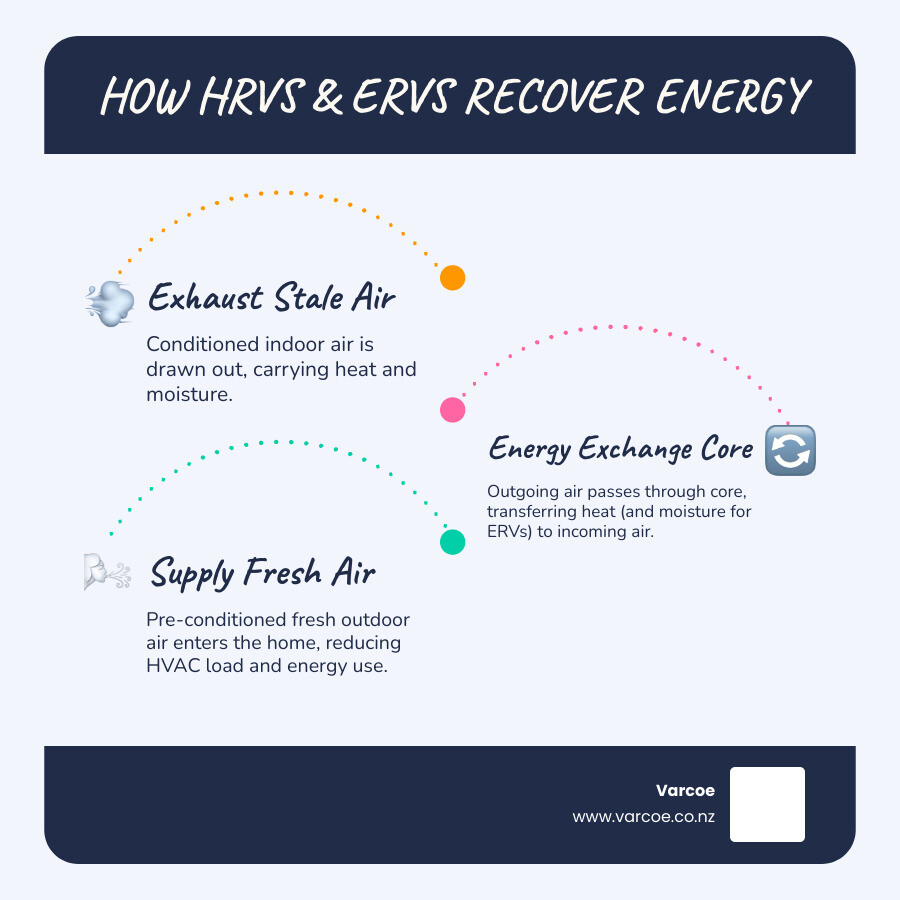
Heat Recovery Ventilators (HRVs) and Energy Recovery Ventilators (ERVs) are the pinnacle of ventilation technology. They use a heat exchange core to transfer energy between the stale air going out and the fresh air coming in. The two air streams never mix.
By recovering 70% to 90% of the heat from exhausted air, these systems allow you to have continuous fresh air without a huge energy penalty, integrating perfectly with our Heat Pumps and Air Conditioning solutions.
Getting the best from an advanced ventilation system depends entirely on correct design and installation. This is not a DIY job. Here’s what we focus on for every installation, backed by our 12-month workmanship guarantee:
At Varcoe, we’re committed to providing Auckland homes with the best energy efficient ventilation solutions available. Explore our expert-installed Ventilation Systems and let us help you create a healthier home.
Winter slots fill fast — book now to secure installation!
Energy-efficient ventilation continuously replaces stale indoor air with fresh outdoor air while recovering 70-90% of the heating or cooling energy. It’s crucial for Auckland’s humid climate to prevent condensation, mould, and high energy bills, creating a healthier, drier home.
ENERGY STAR certified fans use high-performance motors and better blade design to provide superior airflow with significantly less energy—around 48% less than standard models. They are also quieter, improving overall comfort.
Start by using bathroom and kitchen exhaust fans correctly. For a complete solution, install a whole-house HRV or ERV system. Ensure your system is serviced annually and filters are cleaned regularly to maintain performance and efficiency.
They are the foundation. Air sealing stops uncontrolled draughts, and insulation reduces the amount of heating or cooling needed. Together, they create an efficient thermal envelope, allowing your ventilation system to work far more effectively and save you money.
An HRV (Heat Recovery Ventilator) transfers only heat, making it suitable for colder, drier climates. An ERV (Energy Recovery Ventilator) transfers both heat and moisture, making it the ideal choice for Auckland’s mixed, humid climate to manage comfort year-round.
Key signs include persistent condensation on windows, musty smells, visible mould, stale or stuffy air, and family members experiencing worsening allergies or respiratory issues indoors.
According to EECA, ventilation can account for 30% of heat loss in a home. By recovering up to 90% of this heat, an HRV/ERV system significantly reduces the workload on your heating system, leading to substantial savings on your power bills.
Using fans or opening windows at night can help, but it’s limited in Auckland’s humid summers. Bringing in warm, moist air can make your home feel stickier. For effective summer comfort, ventilation works best alongside an air conditioning system or an ERV that can dehumidify incoming air.
‘Most Efficient’ models feature ultra-efficient EC motors, advanced heat exchange cores for higher recovery rates, and smart controls that automatically adjust based on indoor CO2 or humidity levels, ensuring optimal air quality and energy use.
Begin by observing the signs of inadequate ventilation mentioned above. Consider a Healthy Homes Assessment to get a clear picture of your home’s current air quality and moisture levels.
Contact us for a free, no-obligation consultation. Our 50 years of experience in Auckland means we understand the unique challenges and solutions for our local homes. We’ll assess your property, discuss your needs, and recommend the most suitable energy efficient ventilation system.
Based on our assessment, we’ll help you select the ideal system, whether it’s an advanced ERV, upgraded spot ventilation, or a combination of strategies, ensuring it’s correctly sized and custom to your budget.
Our certified technicians will expertly install your chosen system, adhering to the highest industry standards. All our installations come with a 12-month workmanship guarantee for your peace of mind.
Once installed, you’ll immediately notice the difference: fresher air, less condensation, and improved comfort. We’ll provide guidance on simple maintenance tasks like filter changes and offer annual servicing to ensure your system continues to perform optimally for years to come.