Choosing a heat pump for your Auckland home involves more than just picking one off the shelf. Get the sizing wrong and you will either be shivering through winter or watching your power bills climb far higher than they should. This guide walks you through exactly how to size a heat pump for every room in a typical New Zealand home, so you can make a confident, well-informed decision before you buy.
A heat pump that is too small will run constantly trying to reach your target temperature and never quite get there. A heat pump that is too large will short-cycle, switching on and off rapidly, which puts excessive wear on the compressor and creates uncomfortable temperature swings throughout the room.
The output capacity of a heat pump is measured in kilowatts (kW). Every room in your home has a heating and cooling load, determined by factors like floor area, ceiling height, insulation quality, window size, sun exposure, and how the room is used. Matching the unit’s capacity to that load is what separates a comfortable, efficient install from one you will regret.
If you prefer to skip the maths, Varcoe offers a free heat pump size calculator on their website, or you can book an in-home assessment and let a licensed technician do the sizing for you.
A widely used rule of thumb in the New Zealand industry is to allow roughly 100 to 150 watts per square metre for standard residential spaces with average insulation. So a 20m² bedroom needs somewhere between 2.0 and 3.0 kW of heating capacity. However, this is only a starting point. You must adjust up or down based on the following:
Insulation: Older NZ homes with minimal wall or ceiling insulation can lose heat two to three times faster than a modern, well-insulated home. If your home has no ceiling insulation or single-glazed windows throughout, add 20 to 30% to your base calculation.
Ceiling height: Standard calculations assume 2.4m ceilings. If you have vaulted or high stud ceilings, calculate the actual room volume (length x width x height) and allow roughly 40 watts per cubic metre instead.
Sun exposure: North-facing rooms in Auckland receive significantly more solar gain, which reduces heating load but increases cooling load in summer. South-facing rooms in winter will need a slightly larger unit.
Occupancy and appliances: Kitchens generate heat from cooking. Living areas with many people generate body heat. Rooms used for home offices with multiple computers also add to the internal heat load.
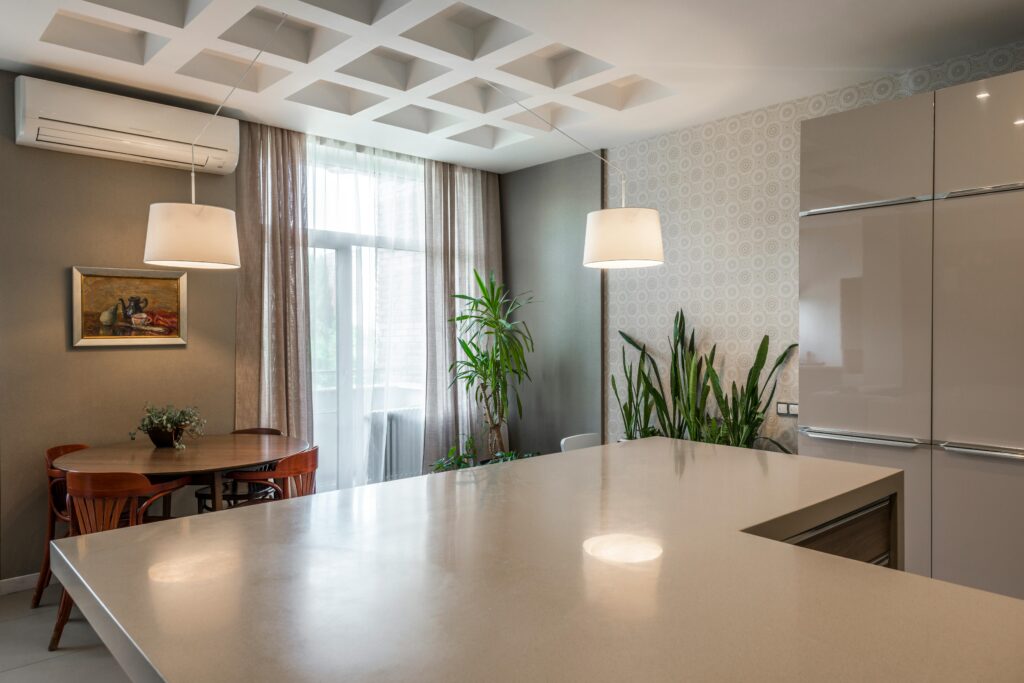
The lounge or living area is usually the heart of the home and where a heat pump will work hardest. Living areas in Auckland homes typically range from 25m² to 50m² for standard homes, though open-plan kitchen/dining/living spaces can exceed 60m².
For a well-insulated open-plan area of 40m² to 50m², look at a unit in the 5.0 to 7.0 kW range. If the space is poorly insulated, older, or has large west-facing windows, lean towards the upper end or consider a 7.0 to 8.0 kW unit.
For larger open-plan areas or homes where multiple living zones connect, a multi-room heat pump system may be more appropriate than a single wall-mounted unit, as it can distribute conditioned air far more evenly.
Most bedrooms in NZ homes sit between 10m² and 20m². A standard double bedroom of around 14m² to 16m² in a well-insulated home will be comfortable with a 2.5 to 3.5 kW unit. For smaller single bedrooms under 12m², a compact 2.0 to 2.5 kW unit will generally suffice.
One thing worth noting for bedrooms: noise matters. Look for units with a low operating sound level, typically in the 19 to 25 dB(A) range on low fan speed.
If you are installing heat pumps across multiple bedrooms from a single outdoor unit, explore Varcoe’s multi-split systems, which connect several indoor units to one outdoor compressor.
A combined kitchen and dining area of around 20m² to 25m² will generally be served well by a 2.5 to 3.5 kW unit. Because kitchens generate their own heat load from cooking appliances, the effective sizing is often slightly smaller than the raw square footage suggests.
A typical home office of 10m² to 15m² with standard insulation will need a 2.0 to 2.5 kW unit. If the office has a lot of computer equipment generating heat, this actually helps with winter heating but increases the summer cooling demand, so do not size down too aggressively.
Garages are almost never insulated and typically have large roller doors that leak heat. For a single garage of around 18m² to 25m² with no insulation, you should be thinking in the 3.5 to 5.0 kW range at minimum. Floor console units can work particularly well here given the layout.
Urban Auckland apartments often have better thermal performance than standalone homes due to shared walls and modern construction. For apartments, work from around 80 to 120 watts per square metre. Varcoe also has a dedicated page on heat pump installation for apartments in Auckland if you want specific guidance for your situation.
If you are retrofitting a heat pump into an existing Auckland home, the insulation, window type, and construction era will heavily influence sizing. Pre-1990s homes in Auckland were typically built with minimal insulation. Always size up rather than down.
For new builds, Varcoe works closely with builders on new build heat pump installation and can advise on the most efficient system design from the start.
For larger homes or homes where comfort is needed throughout, there are a few options:
A ducted whole-home system pushes conditioned air through ceiling ducts to every room from a single central unit. Varcoe installs ducted heat pump systems throughout Auckland.
A multi-split system uses one outdoor unit to power several indoor heads in different rooms, each controllable independently.
A ceiling cassette suits open-plan commercial spaces or larger living areas. See Varcoe’s range of ceiling cassette heat pumps for more detail.
| Room Type | Typical NZ Size | Recommended Capacity |
| Small bedroom | Under 12m² | 2.0 to 2.5 kW |
| Standard bedroom | 12 to 18m² | 2.5 to 3.5 kW |
| Master bedroom | 18 to 25m² | 3.5 to 5.0 kW |
| Kitchen/dining | 15 to 25m² | 2.5 to 3.5 kW |
| Living room | 25 to 40m² | 4.0 to 6.0 kW |
| Open-plan living | 40 to 60m² | 6.0 to 8.0 kW |
| Home office | 10 to 15m² | 2.0 to 2.5 kW |
| Garage (uninsulated) | 18 to 30m² | 3.5 to 5.0 kW |
Bigger is not better with heat pumps. An oversized unit will short-cycle, meaning it reaches the set temperature quickly and switches off, then on again repeatedly. This stresses the compressor, reduces efficiency, and creates humidity issues because the unit does not run long enough to dehumidify the air properly. Correct sizing is essential.
Significantly. A well-insulated room can retain heat 2 to 3 times more effectively than an uninsulated one of the same size. Getting insulation right before or alongside a heat pump installation means you can use a smaller, cheaper unit that runs more efficiently for the life of the system.
Ceiling height is one of the most commonly overlooked factors. A room with 3.0m ceilings has 25% more volume than the same footprint at 2.4m. Use the volume calculation (length x width x height x 40 watts) for any room with ceilings above 2.7m.
In Auckland’s mild climate, heating load is the primary driver in most homes. However, for rooms with significant west-facing glass or open-plan areas that trap afternoon sun, you should check that the unit’s cooling capacity also meets your needs. Most modern inverter units are rated for both, so check both figures on the specification sheet.
If the unit runs for hours without reaching your desired temperature on cold days, it is likely undersized. If the room gets uncomfortably hot before the unit cycles off, or if humidity remains high despite the unit running, it may be oversized. A service technician can confirm this during a routine heat pump service.
Sizing a heat pump correctly from the start saves you money on running costs and avoids the frustration of a unit that never quite does the job. Varcoe has been sizing and installing heat pumps across Auckland since 1975, with over 20,000 installations completed.
Call 0800 088 888 or request a free quote online today.
Varcoe services all Auckland suburbs from Papakura to the North Shore, CBD to West Auckland.