Finding the best portable air conditioning units for Auckland’s humid summers can feel overwhelming, especially when you’re sweltering in a stuffy Ponsonby villa or Mt Eden apartment. With portable units making up a significant part of New Zealand’s room air conditioner market, choosing the right one is crucial for your comfort and wallet.
Quick Answer for Auckland Homeowners:
Auckland’s climate presents unique challenges. High-ceilinged villas and apartments with poor ventilation can become unbearably hot. Portable air conditioners offer flexibility, especially for renters, but they come with trade-offs in efficiency and performance that are important to understand.
Jump Links:
The key is understanding how these units work in Auckland’s specific conditions—from our humidity levels to our unique housing stock and electricity prices.
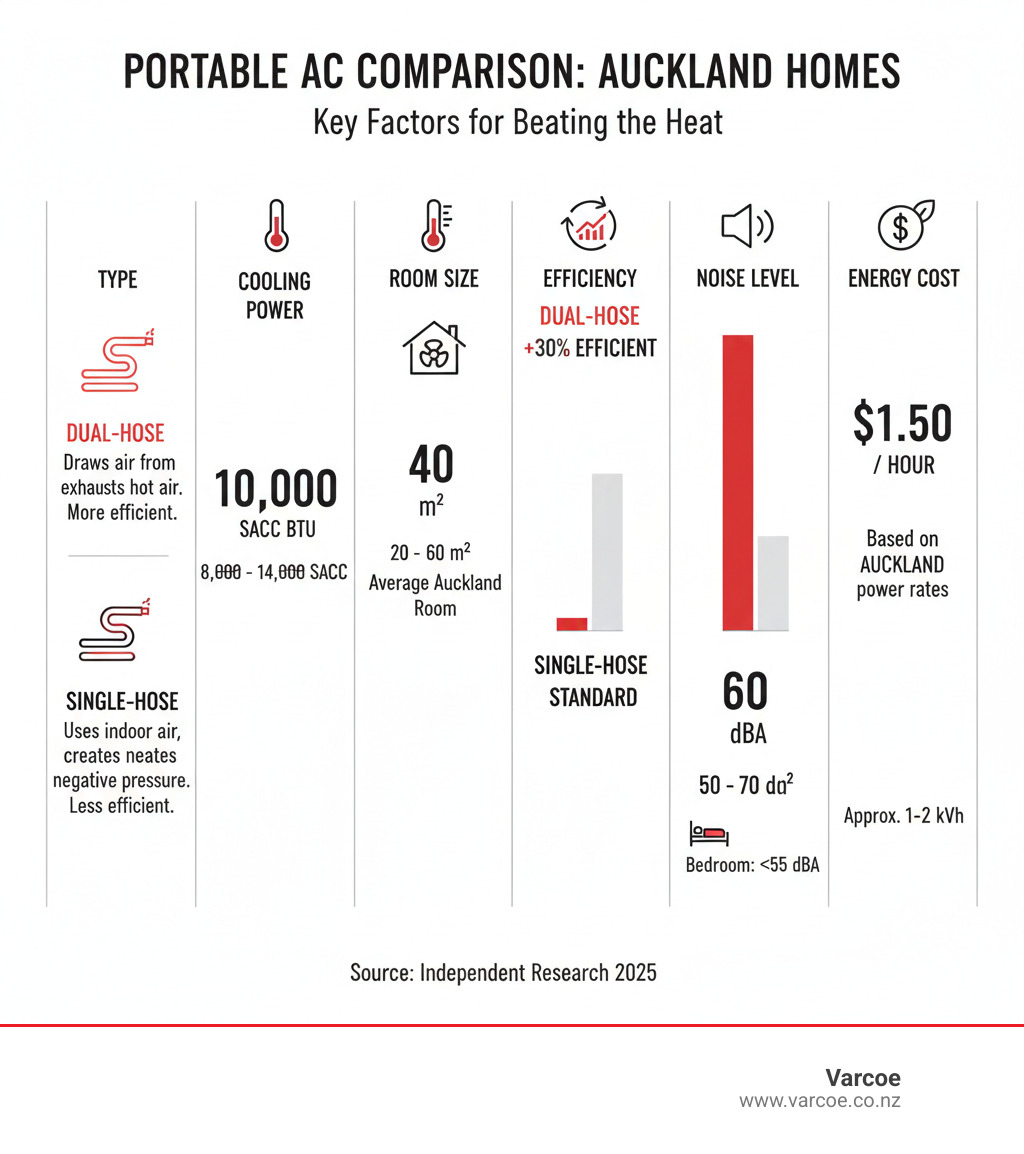
Choosing the right portable air conditioning unit can make a big difference in keeping your home or office comfortable. Here are the key factors to consider when selecting the best options in Auckland.
When the Auckland summer hits, choosing between a portable unit and a fixed system is a key decision. Portable air conditioning units offer best flexibility. You can move them between rooms or take them with you when you move house, making them ideal for renters or for cooling specific areas like a home office. No permanent installation is needed, which is a major benefit for apartments or homes with building restrictions.
However, portable ACs are less efficient than permanent split systems. Single-hose models create “negative air pressure” by exhausting hot air outside, which in turn pulls warm, unconditioned air into the room through gaps in doors and windows. This makes it a constant battle to stay cool. They are a viable solution if your building prohibits window units or if you have sliding windows, but for consistent, energy-efficient cooling, a permanent Air Conditioning solution is a wiser long-term investment.
“We always assess your home’s unique needs before recommending a solution. For some, a portable unit is perfect. For others, a permanent system is a better long-term investment.” – David Reid, Varcoe
Choosing the right size is crucial for comfort and efficiency. An undersized unit will run constantly without cooling the room, while an oversized one will cycle on and off, leading to temperature swings and poor humidity control.
Cooling power is measured in watts (W) or kilowatts (kW). When comparing models, look for the SACC (Seasonally Adjusted Cooling Capacity) rating, which is the most accurate real-world measure of a portable AC’s performance. It accounts for heat generated by the unit and venting losses. As a guide, you need about 63 watts of cooling power per square meter.
Here’s a general guide for matching SACC to room size:
| SACC Rating (kW) | Recommended Room Size (approx. m²) |
|---|---|
| approx. 1.5 kW | Up to 14 m² |
| approx. 2.3 kW | Up to 30 m² |
| approx. 2.9 kW | Up to 40 m² |
| approx. 3.5 kW | Up to 50 m² |
Remember to account for factors like high ceilings, north-facing windows receiving intense sun, and heat-generating appliances, which may require a more powerful unit.
Beyond cooling power, certain features are essential for Auckland’s conditions.
Proper installation and maintenance are key to your unit’s performance and lifespan.
Installation: Most units come with an adjustable window kit for venting exhaust. It’s crucial to seal any gaps around the kit with foam insulation to prevent warm air from leaking back in. While most kits fit standard sliding windows, casement or louver windows may require a custom solution.
Draining: As ACs dehumidify, they collect water. Self-evaporating units expel most of this moisture with the exhaust air, which is a major convenience. In Auckland’s high humidity, even these may require occasional manual draining. Basic models will need frequent emptying of a collection tray.
Maintenance Checklist:
For replacement parts like hoses, you can check resources like Ambient Stores.

When it comes to finalizing your choice, understanding running costs and overall value is essential. Varcoe’s expert guidance can help you make a well-informed decision that suits both your needs and budget.
While the upfront price of a portable AC is tempting, the long-term running costs are a critical factor, especially with Auckland’s electricity prices.
The Reality of Energy Consumption
A typical 2.5 kW portable unit running for 8 hours a day can use 20 kWh, costing around $6.00 per day based on Auckland’s average electricity price of $0.30 per kWh (Gen Less, MBIE data). Over a three-month summer, that can add up to $540.00 in electricity costs alone.
This highlights the value of a permanent solution. When you compare that running cost against a $150 annual service for an efficient heat pump, which prevents $300-$500 emergency call-out fees or a catastrophic $3,000+ compressor replacement, the long-term financial sense becomes clear.
To minimise portable AC running costs, ensure the unit is sized correctly, choose a dual-hose model, seal window gaps, use timers, and keep filters clean. For budget buyers, models like the SereneLife SLPAC10 offer basic cooling. For large rooms, the Whynter ARC-1230WN is a strong contender. For bedrooms, quieter models like the Midea Duo Smart Inverter are worth the investment.
While portable units are great for spot cooling, many Auckland homeowners find their limitations in our intense summers. The higher running costs, noise, and constant maintenance often lead them to consider a permanent system.
Modern heat pumps and air conditioning systems offer superior energy efficiency, whisper-quiet operation, and whole-home comfort. Whether it’s a Single Room Air Conditioner or a comprehensive ducted Domestic Air Conditioning & Heat Pumps solution, a permanent system adds property value and provides consistent comfort year-round, often including efficient heating.
With over 50 years of Auckland experience, we understand how to cool everything from Ponsonby villas to Mt Eden apartments. Our 12-month workmanship guarantee on all installations provides peace of mind. We deliver custom, energy-efficient solutions backed by expert installation and reliable after-sales service. The long-term value is undeniable when you weigh the running costs of a portable unit against the efficiency and comfort of a professionally installed system.
Based on an average electricity price of $0.30/kWh, a typical 1.2 kW unit running 8 hours a day costs about $2.88 daily, or over $86 per month. Over a summer, this can exceed $250. This running cost is why many consider investing that money into a more efficient, permanent heat pump solution instead.
Yes, they are generally louder than split systems as the entire unit is in the room. Noise levels range from 55 dBA (a refrigerator) to over 60 dBA (a busy office). For quieter operation in bedrooms, look for models like the Midea Duo Smart Inverter (55.4 dBA) or the LG LP1022FVSM (56 dBA).
It depends. Many modern units are self-evaporating, expelling moisture with the hot air. However, in Auckland’s high humidity, even these may need occasional draining. Basic models without this feature will require frequent manual draining, which can be a hassle.
Dual-hose units are significantly better. They are more efficient because they use outside air to cool the unit, preventing the negative air pressure that single-hose models create. This results in faster, more effective cooling without drawing warm air back into your room.
Match your room’s square metres to the unit’s SACC (Seasonally Adjusted Cooling Capacity) rating. A general rule is 63 watts of SACC per square metre. For example, a 2.9 kW SACC unit can handle up to 40 m². Also, consider factors like ceiling height and sun exposure, which may require more power.
SACC is the most accurate rating. SACC (Seasonally Adjusted Cooling Capacity) is a newer standard that provides a more realistic measure of a portable AC’s performance in real-world conditions, unlike some older rating methods. Always compare units using their SACC rating.
Every two weeks during peak summer use. A clean filter is crucial for efficiency and air quality. Most are easily removed and can be rinsed with water. A dirty filter forces the unit to work harder and use more electricity.
Absolutely. While portables offer flexibility, a permanent system is often the better long-term investment for value, efficiency, and comfort. We specialise in installing high-quality heat pumps and air conditioning systems across Auckland. We offer free, no-obligation quotes and back every installation with our 12-month workmanship guarantee. Visit our Air Conditioning page to learn more.
Choosing the best portable air conditioning units involves balancing immediate needs with long-term goals. While portables offer flexibility, a permanent system often delivers superior value, comfort, and efficiency.
The numbers are compelling. Running a portable AC can cost over $540 in electricity each summer. In contrast, a $150 annual service on a permanent system protects your investment and helps avoid costly $300-$500 emergency call-outs or a $3,000+ compressor replacement.
Don’t wait for the next heatwave. Our installation schedule fills up quickly as summer approaches. Whether you’re in a Ponsonby villa or a Mt Eden apartment, we have the local expertise to design the perfect cooling solution for your home.
Contact Varcoe for a free, no-obligation quote on a permanent air conditioning solution and secure your comfort with our 12-month workmanship guarantee. Our experienced team will provide honest advice to help you decide what makes the most sense for your home and budget.