Heating water is one of the quiet money-burners in a New Zealand home. Most people focus on the power their heaters or appliances use, but hot water heating alone makes up roughly 30 percent of the average Kiwi household’s energy bill. That is a significant slice, and for decades most homes have heated water in the least efficient way possible: with a standard electric cylinder that works like a giant kettle, running through the day and night.
Hot water heat pumps are changing that. They have become one of the most talked-about home upgrades in the country, and for good reason. But the technology is still new to a lot of homeowners, and the bigger upfront price tag puts people off before they understand the numbers. So let’s break down how they actually work, what they cost, and whether they make sense for your home.
A hot water heat pump uses the same basic principle as the heat pumps that warm your living spaces, just pointed at a water tank instead of a room. The simplest way to picture it is a refrigerator running in reverse.
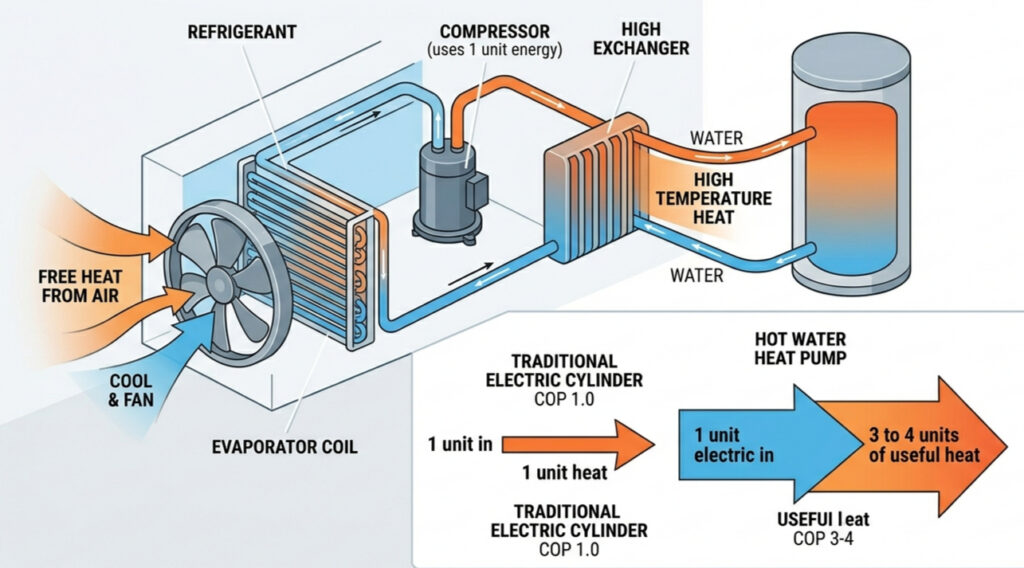
Your fridge pulls heat out of the food compartment and dumps it into the room. A hot water heat pump does the opposite. It draws warmth out of the surrounding air, concentrates it using a refrigerant and a compressor, and transfers that heat into the water stored in a tank. A fan circulates air across an evaporator coil, the refrigerant absorbs the ambient heat, the compressor raises its temperature, and that energy is passed into the water.
The clever part is that the system is moving heat rather than creating it from scratch. A traditional electric element turns one unit of electricity into one unit of heat. A hot water heat pump turns one unit of electricity into three or four units of heat, because most of the energy comes from the free warmth already in the air around it. This ratio is called the Coefficient of Performance, or COP. A standard cylinder has a COP of 1.0. A good hot water heat pump sits around 3 to 4, and some of the better models engineered for New Zealand conditions push higher than that.
There are a few different configurations. An integrated unit has the heat pump and the storage tank combined in one cabinet. A split system separates the heat pump from the tank, similar to how a standard heat pump has an outdoor and indoor unit. And in some cases you can retrofit a heat pump to work with an existing cylinder, provided that cylinder is mains pressure and reasonably new.
Here is where the honest conversation needs to happen. A hot water heat pump costs more to buy and install than a basic electric cylinder. Figures from EECA put the average at around $7,000 to $7,500 including purchase and installation, with the most efficient or larger systems costing more.
That is a real number, and it is fair to feel a bit of sticker shock. But the running costs tell the other half of the story. EECA estimates a hot water heat pump uses around 60 to 75 percent less electricity than a conventional electric cylinder. For the average household that translates to savings of roughly $284 a year, and households that use a lot of hot water can save considerably more, with some estimates landing between $400 and $700 annually.
Over the 15 to 20 year life of the unit, those annual savings stack up into thousands of dollars. The typical payback period sits somewhere between four and seven years depending on your household size, your electricity tariff, and how much hot water you actually use. After the payback point, every year is money back in your pocket.
If you are weighing up the whole picture of running costs, it is worth thinking about how your hot water sits alongside your other systems. The same logic that makes a heat pump cheaper to run for heating water applies across the home, and there are practical ways to cut your home’s energy costs that work together rather than in isolation.
A common worry is that a system pulling heat from the air will struggle when the air gets cold. There is some truth here. Efficiency does drop in colder weather because there is less ambient heat to harvest, and the unit has to work a little harder.
For most of the country this is a non-issue. Auckland and the upper North Island have mild temperatures that are close to ideal for heat pump efficiency. Even in cooler regions, many modern units are engineered to keep performing in low temperatures, with some rated to operate down to minus 10 degrees Celsius. The dip in winter efficiency is real but rarely enough to undo the savings.
The other practical consideration is noise and placement. Because a hot water heat pump runs a fan and a compressor, it makes more sound than a silent electric cylinder. For that reason the units are usually positioned outside or in a spot where the noise will not bother anyone. A bonus of outdoor placement is that you free up the cupboard space your old cylinder used to occupy.
The answer depends on your situation, and a good installer will tell you that rather than pushing a one-size-fits-all upgrade. A hot water heat pump makes the strongest case when:
It makes less sense if you are on a very tight budget right now, if your hot water use is genuinely low, or if you are likely to move house in the next year or two. In those cases the maths is less compelling, and a standard cylinder may still be the pragmatic choice for the short term.
If you are upgrading your home’s heating and efficiency more broadly, it can be smart to start with an energy audit so you understand where your power is actually going before you spend. It is also worth checking what grants and subsidies you can claim in 2026, since the right support can change the numbers in your favour.
With proper installation and routine maintenance, most hot water heat pumps last between 15 and 20 years. This is comparable to, and often longer than, the lifespan of a standard electric hot water cylinder. Much of the value comes from the ongoing energy savings achieved over the life of the system.
In some cases, yes. Retrofitting is often possible if your existing cylinder is mains pressure and less than eight years old. This can significantly reduce the upfront investment compared to replacing the entire system, making it worthwhile to have your current setup professionally assessed.
No, provided the system is correctly sized for your household. Like a traditional cylinder, a hot water heat pump stores heated water in a tank, ensuring a reliable supply when demand is matched to system capacity. Choosing a unit that is too small for your household can lead to shortages, which is why proper sizing is essential.
Hot water heat pumps produce more noise than a standard electric cylinder because they use a fan and compressor. However, the sound level is generally similar to a typical outdoor heat pump unit. Installers usually position systems in locations that minimise noise impacts on bedrooms and living spaces.
The higher purchase and installation cost is the main consideration for most homeowners. Other factors include a slight reduction in efficiency during very cold weather and the need for a suitable installation location. For households planning to stay in their home long term, the energy savings often outweigh these drawbacks over time.
Working out whether a hot water heat pump suits your home comes down to your usage, your existing system, and your plans for the property. Those are exactly the questions our team has been answering for Auckland homeowners for over 50 years, across more than 20,000 heating and cooling installations.
If you want a clear, honest assessment rather than a sales pitch, get a free quote or call us on 0800 088 888. We will help you understand the real numbers for your home, so you can make the call with confidence.