A ground source heat pump sizing calculator is an online tool that estimates the required heating and cooling capacity for your geothermal system based on your home’s characteristics, local climate, and ground conditions.
Quick Answer for Ground Source Heat Pump Sizing:
Ground source heat pumps (also called geothermal heat pumps) extract consistent heat from the earth’s stable underground temperatures. Unlike air source systems that struggle in extreme weather, these systems deliver reliable heating and cooling year-round.
But here’s the catch: sizing matters more than you might think.
As one industry expert notes: “A heat pump that is 15-30% oversized can run inefficiently and cost thousands more to install.” The research shows that simple sizing rules can vary wildly – estimates for a 2,000 square foot house range from 20,000 BTU to 120,000 BTU depending on the method used.
Getting the size right means consistent indoor temperatures, lower energy bills, and a system that lasts decades. Get it wrong, and you’ll face short-cycling, poor humidity control, and potentially thousands in wasted installation costs.
That’s where a ground source heat pump sizing calculator becomes your starting point for making informed decisions about your home’s comfort system.
Think of sizing your ground source heat pump like buying the perfect pair of shoes. Too big, and you’ll be clunky and uncomfortable. Too small, and you won’t even get them on properly. The same “bigger is not better” principle applies to your geothermal system, and getting it wrong can cost you thousands.
Your ground source heat pump sizing calculator might give you a starting estimate, but understanding why precise sizing matters will help you make better decisions when investing in your home’s comfort.
An oversized heat pump creates problems you might not expect. The biggest culprit is short-cycling, where your system turns on, quickly satisfies the thermostat, then shuts off again. It’s like a car constantly starting and stopping in traffic, which is terrible for fuel economy and even worse for your electricity bill.
This constant on-off cycle leads to poor dehumidification during Auckland’s humid summers. Your home might feel cool but clammy because the system doesn’t run long enough to pull moisture from the air. Nobody wants that sticky feeling when they’re trying to relax at home.
The increased wear and tear from all that starting and stopping puts serious stress on your compressor and other components. Think of it as aging your system in fast-forward. What should last decades might need repairs within a few years.
All this inefficiency translates directly to higher running costs. Despite having more capacity, an oversized system actually uses more energy because it never reaches its optimal operating efficiency. Plus, you’ll pay more upfront for that extra capacity you don’t actually need.
An undersized system creates a different kind of frustration. During peak heating or cooling periods, it simply can’t keep up with your home’s demands. You’ll find yourself dealing with inadequate heating in winter and insufficient cooling in summer, which defeats the entire purpose of investing in a comfort system.
Your system will lean heavily on its backup electric resistance heater, leading to over-reliance on backup heat. This auxiliary heating is far less efficient and much more expensive to run than your heat pump. It’s like having a sports car but only being able to use first gear.
The result is obvious discomfort throughout your home. Cold spots, drafts, and uneven temperatures become the norm rather than the exception.
Here’s where the numbers get serious. The upfront cost impact of incorrect sizing can add thousands to your installation. An oversized unit costs more to buy, more to install, and more to run. Research shows that a heat pump just 15-30% oversized can significantly impact both installation costs and ongoing efficiency.
But the long-term savings of proper sizing make it worthwhile. A correctly sized system optimises your initial investment against maximum energy savings. You’ll see faster returns and enjoy decades of reliable, low-cost comfort. Most importantly, proper sizing directly impacts system longevity. A well-matched system can last 20-25 years, while an incorrectly sized one might need replacement much sooner.
Getting your sizing right isn’t just about comfort today. It’s about protecting your investment for the next two decades. For more details on how we ensure optimal system performance, check out our heat pump services.
Think of a ground source heat pump sizing calculator like a recipe for the perfect cup of coffee. You wouldn’t just throw in any old amount of coffee grounds and hope for the best. You’d carefully measure the beans, consider the water temperature, and adjust for your taste preferences. The same careful approach applies to sizing your geothermal system.
The difference is, instead of coffee and water, we’re working with your home’s unique characteristics, the earth beneath your feet, and the system design that ties it all together. Miss one ingredient, and your comfort could be compromised for decades.
Here’s what any reliable calculator needs to get right:
Your house tells a story through its construction, and every detail matters when it comes to heating and cooling loads.
Square footage and ceiling height form the foundation, but they’re just the starting point. A 2,000 square foot home might need anywhere from 20,000 BTU to 120,000 BTU depending on other factors. That massive range shows why simple rules of thumb can lead you astray.
Insulation levels in your walls, ceiling, and floor act like a thermal blanket around your home. Brilliant insulation means your heat pump works less and costs you less. Poor insulation? Your system will be working overtime, and your power bills will show it. Our Healthy Homes Assessment can help you understand exactly where your home stands.
Window type and orientation create another layer of complexity. Double glazing keeps heat where it belongs, while Low-E coatings work like sunglasses for your windows. The direction matters too. North-facing windows in New Zealand catch more sun, which affects your cooling load in summer.
Air leakage rate is the hidden culprit that many homeowners overlook. Those tiny gaps around doors, windows, and where pipes enter your home might seem insignificant, but they add up. Even professional sizing software shows dramatic differences. Adjusting just one input, like moving ductwork from an unconditioned to a conditioned space, can change the heating load estimate by almost half a ton.
The IGSHPA professional design tools dive deep into these details because they matter. A lot.
The ground beneath your home isn’t just dirt. It’s your heat pump’s energy source, and its characteristics directly influence your system’s performance.
Local climate zone sets the stage for everything else. Auckland’s mild climate creates different demands than the South Island’s colder regions. Design temperatures tell us the extremes your system needs to handle. The design heating temperature is typically the coldest outdoor temperature that occurs only 1% of the time during winter.
Ground thermal conductivity measures how well heat moves through your soil. Think of it like the difference between stirring honey and stirring water. Clay soil, especially when moist, transfers heat beautifully. Dry, sandy soil? Not so much.
Soil type and water table depth work together to influence this thermal conductivity. Wet, dense soil generally performs better for heat transfer, though a high water table can complicate installation.
Your ground loop configuration shapes your entire system’s performance, and there’s no one-size-fits-all solution.
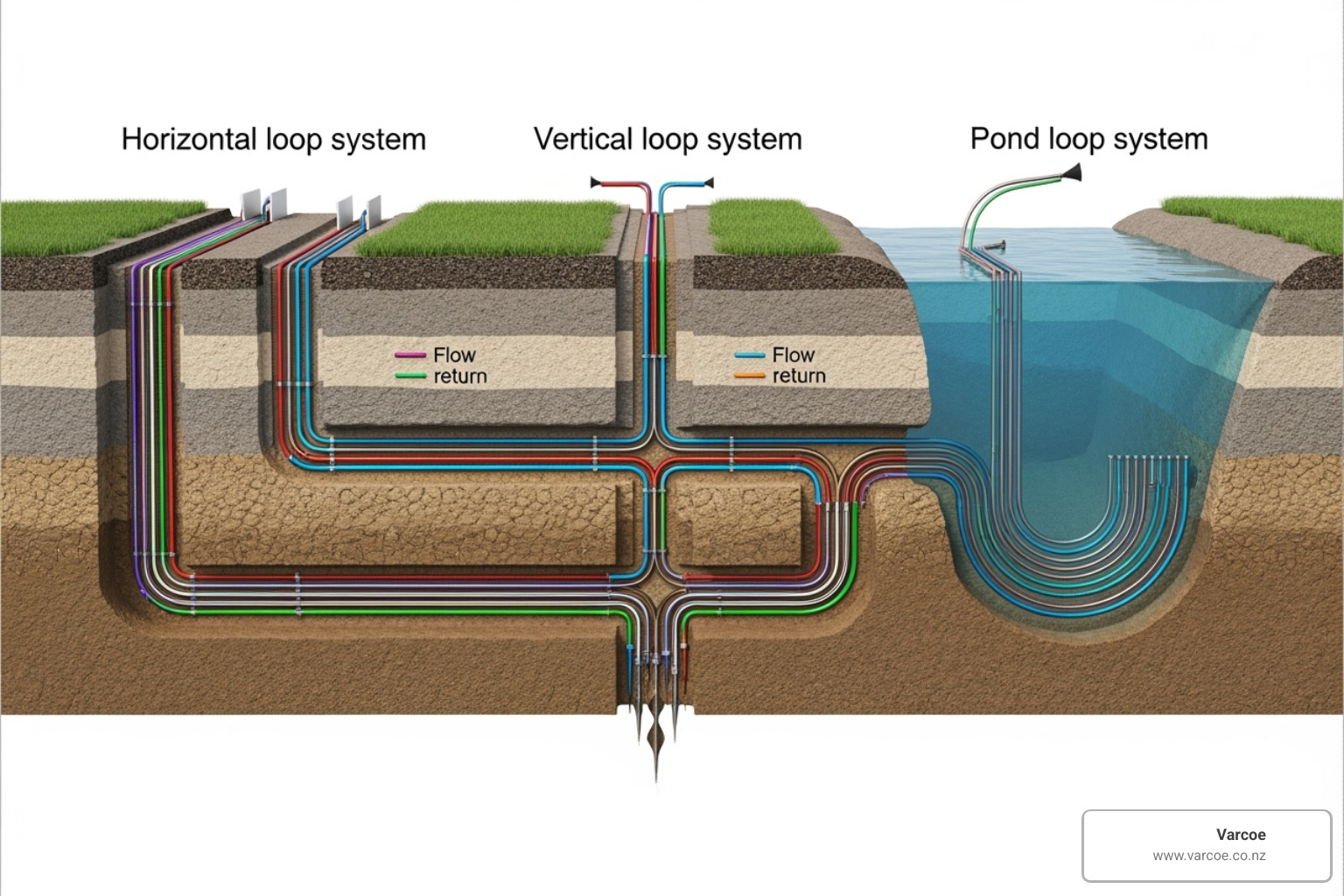
Ground loop types each have their place. Horizontal loops spread out in shallow trenches, perfect if you have the land area and want to keep drilling costs down. Vertical loops go deep, ideal for smaller sections but with higher installation costs. Pond or lake loops submerged in water can be incredibly efficient if you’re fortunate enough to have a suitable water source nearby.
Loop length and depth determine how much surface area your system has for heat exchange. It’s a delicate balance that must match your home’s heating and cooling demands perfectly.
Heat pump unit efficiency, measured as COP for heating and EER for cooling, tells you how much heating or cooling you get for each unit of electricity. Higher efficiency units can sometimes achieve the same comfort with slightly smaller capacity, but this balance requires careful calculation.
These factors work together like instruments in an orchestra. Miss one, and the whole performance suffers. That’s why our team at Varcoe takes a comprehensive approach with our domestic air conditioning and heat pumps, ensuring every component works in harmony with your home and Auckland’s unique conditions.

Getting your ground source heat pump sized correctly is a bit like planning a cross-country road trip. You wouldn’t just guess how much fuel you need or pick a route at random. Instead, you’d start with a rough estimate, check the proper maps, and maybe even consult someone who’s made the journey before.
The same thoughtful approach applies to sizing your geothermal system. Let’s walk through each step of this journey together.
Think of a ground source heat pump sizing calculator as your first glimpse at the map. These online tools are brilliant for getting your bearings, but they’re definitely not the final word on your system size.
What these calculators do well is give you a starting point for conversations and budgeting. Pop in your square footage, select your insulation type, and you’ll get a ballpark figure that helps you understand whether you’re looking at a 2-ton system or a 5-ton beast. It’s particularly useful when you’re in the early stages of planning and want to understand potential costs.
But here’s where things get interesting (and a bit frustrating). These simple calculators have some pretty significant limitations. They’re working with broad assumptions that might not match your home at all. We’ve seen estimates for the same 2,000 square foot house vary from 20,000 BTU to 120,000 BTU depending on the method used. That’s a massive difference!
Most online tools can’t account for the specific details that really matter. They don’t know about your gorgeous north-facing windows that flood your living room with winter sun, or that your home sits on clay soil with excellent thermal conductivity, or that your teenage daughter’s bedroom is always 5 degrees warmer than the rest of the house thanks to her gaming setup.
When you get your results, treat them as a conversation starter, not gospel truth. If the calculator suggests a 3-ton system, think of it as “somewhere around 3 tons, give or take.” It’s a useful reference point for your next steps, but definitely not your final answer.
Now we’re getting into the serious territory. Manual J is the industry’s gold standard for load calculations, and it’s about as thorough as you can imagine. Think of it as the detailed engineering survey before building a bridge.
This comprehensive calculation method, developed by the Air Conditioning Contractors of America, digs into every aspect of your home that affects heating and cooling. We’re talking about a 627-page document that considers everything from your wall construction and window orientation to how many people live in your home and what appliances you run.
Manual J factors in your building envelope (all those walls, windows, and insulation details), your home’s orientation to the sun, air infiltration through those sneaky gaps around doors and windows, and even the internal heat gains from your family’s daily activities. It also considers your local climate data with precision that would make a meteorologist proud.
Why leave this to the professionals? Well, the software that performs these calculations is complex, and the inputs require expertise to determine accurately. Our research shows that changing just one input, like whether your ductwork runs through conditioned or unconditioned space, can alter the heating load estimate by almost half a ton. That’s the difference between comfort and constantly adjusting your thermostat!
Even with all this precision, Manual J isn’t foolproof. The calculations can sometimes overestimate loads if not properly interpreted by someone with experience. That’s why the next step is so crucial.
This is where the magic happens. No amount of online calculating can replace an experienced installer walking through your home with a keen eye and proper measuring tools.
A quality professional assessment involves far more than a quick walk-through. We’re talking about someone who understands Auckland’s climate patterns, knows how different building materials perform over time, and can spot potential issues that might affect your system’s performance years down the track.
During their visit, a skilled installer will measure everything that matters. Room dimensions, window sizes, insulation levels, and they’ll examine your existing ductwork for leaks or sizing issues. They’ll note unique features like that beautiful but thermally challenging cathedral ceiling in your lounge, or the way your home is tucked into a hillside that affects wind patterns.
For ground source systems, the ground assessment is particularly crucial. Your installer needs to understand your soil type and thermal conductivity, assess available space for horizontal loops or suitable drilling locations for vertical systems, and consider your local water table. These factors directly impact how efficiently your system can exchange heat with the earth.
Here’s a red flag worth remembering: if someone gives you a quote after a 20-minute visit (or worse, over the phone), run the other way. Proper sizing takes time and attention to detail. A rushed assessment almost always leads to an oversized system, which costs more upfront and wastes energy for decades.
Professional installers also use Specialised tools for pump sizing that ensure every component of your ground source system works in perfect harmony. It’s this attention to detail that transforms a good system into a great one that serves your family reliably for years to come.
When it comes to ground source heat pumps and sizing, we hear the same questions time and again from Auckland homeowners. Let’s tackle the big ones that matter most to your comfort and wallet.
This is brilliant question that gets to the heart of why ground source systems are so remarkable! The key difference is all about where they get their heat from.
Air source heat pumps work with whatever temperature Mother Nature throws at them. On a freezing winter morning, they’re trying to squeeze heat out of 2°C air. On a scorching summer day, they’re attempting to dump heat into 35°C air. It’s like trying to cool down by jumping into a hot bath!
Ground source heat pumps, on the other hand, tap into the earth’s incredibly stable underground temperatures. Just a few metres down, the ground stays at a lovely, consistent 15-18°C year-round here in Auckland. Whether it’s the middle of winter or the peak of summer, your ground loop is working with that same mild temperature.
This stability makes all the difference. While an air source heat pump’s efficiency drops dramatically when outdoor temperatures become extreme, a ground source system maintains its higher efficiency throughout the year. It’s like having a personal climate-controlled workspace while everyone else is battling the elements!
The trade-off? Installation requirements are more involved. Ground source systems need excavation for horizontal loops or drilling for vertical ones. Air source units are simpler to install, but they can’t match the consistent performance that comes from working with the earth’s steady temperatures.
Getting the sizing wrong is like buying a car with the wrong-sized engine. Too small, and you’ll struggle up every hill. Too big, and you’ll waste fuel and money at every turn.
With an oversized system, you’re looking at short cycling that wastes energy on constant startups and stops. Your home feels uncomfortable because the system doesn’t run long enough to properly dehumidify the air. Plus, all that stopping and starting wears out components faster than they should.
An undersized system leaves you cold in winter and warm in summer because it simply can’t keep up. It ends up relying heavily on expensive backup electric heating, which defeats the purpose of investing in an efficient heat pump in the first place.
Both scenarios hit you where it hurts most: higher running costs and reduced system lifespan. You might pay thousands more upfront for an oversized unit, then watch it consume more energy and break down sooner. An undersized system costs less initially but fails to deliver the comfort you paid for.
As industry experts note, a system that’s even 15-30% oversized can run inefficiently and cost thousands more to install. The “bigger is not better” principle isn’t just a catchy phrase – it’s your wallet’s best friend.
Think of your ground loop as the foundation of your entire system. Just like you wouldn’t put a mansion on a cottage foundation, you can’t expect great performance from a mismatched ground loop and heat pump combination.
The ground loop and heat pump unit work as partners, not independent components. If your ground loop is too small, it can’t effectively exchange enough heat with the earth. This forces your heat pump to work harder, dropping its efficiency and potentially leaving your home uncomfortable during peak heating or cooling days.
The loop’s thermal transfer capacity depends on several factors: how long it is, whether it’s horizontal, vertical, or in a pond, and what type of soil surrounds it. Clay soil transfers heat differently than sandy soil, and these differences matter when calculating the right loop size.
This is where specialised tools become essential. Professional installers use sophisticated calculators to ensure your ground loop can handle your home’s peak loads while maintaining the temperatures your heat pump needs to operate efficiently. You can explore some of these specialised tools for pump sizing to understand the complexity involved.
The bottom line? Both components must be perfectly balanced. You could have the most efficient heat pump available, but if the ground loop can’t support it properly, your whole system underperforms. That’s why using a reliable ground source heat pump sizing calculator is just the starting point – professional design ensures every piece works together beautifully.
We’ve journeyed through the fascinating world of ground source heat pump sizing calculators and finded just how crucial getting the sizing right truly is for your home. From understanding your home’s unique thermal fingerprint to appreciating the delicate balance between your heat pump unit and its underground loop system, it’s clear this isn’t a simple “one size fits all” situation.
Online calculators serve as brilliant starting points for getting that initial ballpark figure. They’re like having a friendly chat with a knowledgeable mate who gives you a rough idea of what you might need. But here’s the thing: they simply can’t account for all those unique quirks that make your property special. Your north-facing windows, that draughty door, or the specific clay soil in your backyard all matter enormously.
Relying solely on a quick online estimate or a simple rule of thumb is a bit like trying to tailor a suit using only your height. It might be close, but it won’t be the perfect fit you deserve. An improperly sized system becomes a costly mistake that keeps on giving: higher running costs, reduced comfort, and a system that gives up the ghost years before it should.
The rewards of getting it right are genuinely exciting. A correctly sized ground source heat pump delivers consistent year-round comfort regardless of Auckland’s weather moods. You’ll see significantly lower energy bills that make you smile every month, and you’ll have a robust system that keeps humming along reliably for decades. This is genuinely an investment in your home’s future and your family’s daily comfort.
At Varcoe, we’ve been perfecting home comfort solutions for over 50 years right here in Auckland. We understand our local climate inside and out, from the humid summers to those surprisingly chilly winter mornings. We know the challenges different property types present and the importance of custom, energy-efficient solutions that actually work.
Our team doesn’t just sell heat pumps and call it a day. We design and install complete comfort systems, ensuring every single component works in perfect harmony. From the underground loop to your indoor unit, everything is precisely matched to your specific needs. We take pride in expert installation and solid after-sales support because we believe your comfort shouldn’t end the day we finish the job.
Don’t leave something as important as your home comfort to guesswork or generic estimates. Use our comprehensive Heat Pump Calculator to get started or contact us for an expert consultation. Let us help you open up the ultimate in home comfort and energy savings with a perfectly sized ground source heat pump system that’s custom just for you.