What to check before an HVAC contractor starts work on your building
A contractor turns up at a 1980s office block in the CBD to swap out a rooftop unit. He’s on the roof by 8am, ladder against the parapet, refrigerant lines already run through the plant screen. If something goes wrong up there, whose problem is it?
Most building owners assume the answer is simple: it’s the contractor’s problem, because the contractor is the one on the roof. Under New Zealand law, that’s not how it works. When you hire someone to work on your building, you don’t hand over your health and safety obligations along with the job. You keep them. So does the contractor. Both of you are on the hook at the same time, for the same work.
That matters more than most property managers, facilities managers and body corporate committees realise, and it changes what you should actually be asking before you let someone start work.
Under the Health and Safety at Work Act 2015, a business that hires a contractor is called a PCBU – a “person conducting a business or undertaking”. So is the contractor. When two or more PCBUs have a duty relating to the same piece of work, the law calls that an overlapping duty, and each party has to consult, cooperate and coordinate with the others, so far as is reasonably practicable.
WorkSafe puts it plainly: a PCBU cannot contract out of its duties. Signing a contract that says “the contractor is responsible for all health and safety” doesn’t achieve what you might think it does. WorkSafe also expects the party at the top of a contracting chain – that’s you, if you own or manage the building – to lead on good practice rather than push the risk down to whoever’s doing the physical work. If something goes wrong, WorkSafe can and does consider enforcement action against more than one party.
None of this means you need to supervise every job personally. It means the questions you ask before work starts are part of meeting your own legal obligations, not just idle due diligence.
Commercial HVAC work often gets filed alongside general maintenance in people’s minds, somewhere between changing lightbulbs and fixing a leaky tap. On site, it looks different.
Technicians work at height on roofs and parapets to access outdoor units. They work inside ceiling voids, often above occupied tenancies, running pipework and cabling through confined and awkward spaces. They handle refrigerant under pressure. They carry out live electrical work on switchboards and circuits. Larger commercial jobs involve craneage to lift plant onto a roof, sometimes over a public footpath. A lot of this happens after hours, in a building the crew doesn’t know as well as the people who work there every day.
None of that is a reason to avoid the work. It’s a reason to expect a contractor who plans for it properly, rather than one who shows up with a van and a ladder and figures it out as they go.
Here’s one most people don’t think to raise, and it’s specific to older commercial buildings.
Any building built or renovated before 2000 should be assumed to contain asbestos until it’s been checked. That’s the working rule under the Health and Safety at Work (Asbestos) Regulations 2016, and Auckland has more of this building stock than anywhere else in the country. Asbestos was used across roofing, cladding, wall linings, ceiling tiles and insulation right through to the turn of the century, and it stays inert and harmless until someone disturbs it.
Installing HVAC plant in an older building almost always disturbs something. Core-drilling for pipe runs through a concrete or fibre-cement wall. Cutting into linings to fix bracketry. Lifting ceiling tiles to run cable and ductwork. Penetrating soffits and cladding to bring pipework outside. Every one of those is exactly the kind of activity that can release asbestos fibres if the material is there and nobody has checked.
WorkSafe attributes around 220 deaths a year in New Zealand to asbestos-related disease – more than any other cause linked to work. The risk isn’t hypothetical, and it isn’t limited to demolition crews. A technician who stops, asks whether the building has been surveyed, and waits for an answer before drilling is protecting your liability along with their own health. A technician who doesn’t ask is a risk you’ve inherited whether you knew it or not.
You might expect “licensed HVAC technician” to be a straightforward box to tick, the way it is for electricians or plumbers. It isn’t. A licensing scheme for refrigeration, heating and air conditioning technicians was agreed by government back in 2019, but the work on it is currently on hold while a wider review of the health and safety system runs its course. There’s no general trade licence to check.
What you can verify instead:
Any electrical work on your job should be carried out by an EWRB-registered electrician, and you should receive a Certificate of Compliance or Electrical Safety Certificate confirming the work meets the wiring rules. If nobody mentions this, ask.
Anyone charging a gas cylinder with refrigerant is required to hold this certificate under the hazardous substances regulations. It’s issued by a WorkSafe-authorised compliance certifier and confirms the person knows how to handle pressurised refrigerant safely.
Site Safe’s SiteWise system, or an equivalent scheme, gives you an independent check on a contractor’s safety systems before they set foot on your property. A current rating is worth more than a claim on a website.
You want cover in place, and you want a plan written for your building, not a generic template with the site address changed.
None of this guarantees a perfect job. It gives you a way to tell the difference between a contractor who takes safety seriously and one who’s counting on you not to ask.
The paperwork tells you a contractor is set up to work safely. What happens on the day tells you whether they actually do.
Before work starts, expect a site-specific safety plan and a proper induction, not a five-minute chat at the door. Expect a task-specific risk assessment for what’s actually happening on your building, and a toolbox talk at the start of the job so the crew knows what they’re walking into. Expect isolation and permit-to-work discipline around live electrical work and plant shutdowns. Expect a tidy site during and after the job, and a genuine channel for reporting near misses, not just a form nobody reads.
You should also have one point of contact who can answer a safety question on the spot, without disappearing to “check with the office.”
A safety management system gets a contractor through prequalification. What happens on a wet Thursday afternoon, three hours into an awkward ceiling job, is a different test.
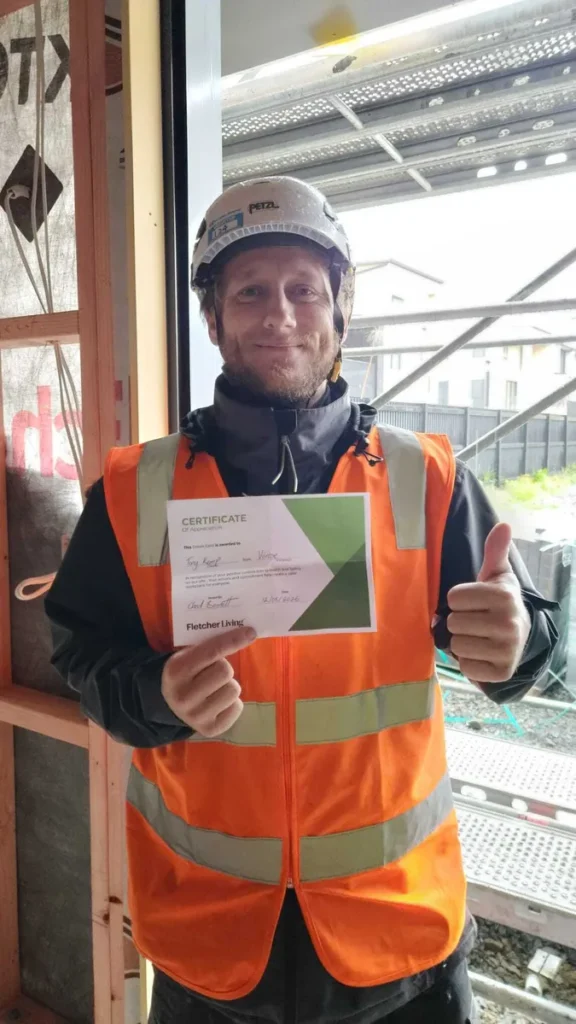
Recognising the people who put safety first
We were proud to see one of our technicians, Tony, recognised on a major Auckland site with a Certificate of Appreciation for his contribution to health and safety. The recognition came down to how he works day to day – looking out for himself and the rest of the crew, speaking up when something needs saying, keeping the job moving without ever cutting a corner to do it. Safety taken seriously, with a smile still on the job. That’s exactly the kind of thing worth recognising.
Safety on a job site comes down to people who take it seriously without making it grim. A crew that can have a laugh and still stop the moment something looks wrong is exactly what you want in your building.
Keep this list handy for your next contractor conversation:
You can’t hand your health and safety duties to a contractor along with the keys to the plant room. You share them. The good news is that sharing a duty properly is straightforward once you know what to ask for, and a contractor with nothing to hide will answer every one of these questions without blinking.
We’ve been installing and maintaining commercial air conditioning, industrial air conditioning and commercial refrigeration across Auckland for fifty years, with our own electrical team so there’s no gap between the HVAC work and the electrical work behind it. If you’re planning a commercial install or want a second opinion on a maintenance contract, get in touch and we’ll talk through what your building actually needs.