There is a common assumption among wine lovers who are building their first serious collection. If wine needs to be kept cool, then surely a cold room, a basement corner, or even a spare fridge will do the job. It sounds logical, and it is one of the most expensive mistakes a collector can make.
Wine is a living product that keeps evolving in the bottle for years, and the conditions around it decide whether that evolution produces something remarkable or something ruined. Temperature is only one part of the equation. Humidity, stability, air quality, vibration, and light all play a role, and a basic cold room controls almost none of them properly.
At Varcoe, we have been designing and installing refrigeration and climate systems across Auckland since 1975, including purpose-built wine cellar design, installation, and maintenance for both homes and commercial venues. In this article, we explain exactly why a true wine cellar needs engineered climate control, what goes wrong when it does not have it, and what a properly designed system involves.
A standard cold room or air conditioner has one job. It removes heat until the space reaches a set temperature, then it switches off and waits. For storing beer, soft drinks, or produce, that is perfectly fine. For wine, it creates three serious problems.
Every refrigeration cycle removes moisture from the air as a by-product of cooling. A conventional cold room is actually designed to do this. In a wine cellar, that same drying effect is destructive.
Wine needs relative humidity of roughly 55 to 75 percent. Below that range, natural corks slowly dry out and shrink. A dried cork loses its seal, oxygen creeps into the bottle, and the wine oxidises. You will only discover it years later when you open a prized bottle and find it flat, brown, and lifeless, and by then every bottle in the room has been sitting in the same dry air.
A purpose-built wine cellar system manages humidity deliberately. It cools gently, over longer cycles, so it removes far less moisture from the air. Where the environment demands it, humidification can be added so the cellar holds a stable, cork-friendly range all year round.
Most collectors know that heat harms wine. Fewer realise that fluctuation is just as damaging as heat itself. Wine expands and contracts as temperature moves. Each swing pushes tiny amounts of wine past the cork and draws air back in, a slow pumping action that accelerates oxidation.
A cold room controlled by a basic thermostat typically cycles several degrees either side of its set point. A true cellar conditioning system is engineered to hold a target, usually 12 to 14 degrees Celsius, within a very tight band, day and night, in January and in July.
Here is a technical detail that catches many people out. Ordinary air conditioning systems are built to maintain comfortable living temperatures, generally 18 degrees and above. Ask one to hold a room at 13 degrees and it will struggle, ice up, short cycle, and eventually fail. It was simply never designed for that duty.
Wine cellar cooling uses refrigeration technology closer to what you would find in professional commercial refrigeration systems, engineered for low temperatures, long run times, and precise control. The coil design, refrigerant selection, fan speeds, and control logic are all different. This is why cellar conditioning is a specialist job rather than a variation on a standard heat pump install.
A well-designed cellar is a complete environment, not just a cooled box. When our team designs a cellar system, we consider every one of the following elements.
Before any equipment is selected, the room itself has to be right. A cellar held at 13 degrees inside an Auckland home sits well below the surrounding air temperature for most of the year. Without proper insulation and a sealed vapour barrier, warm moist air migrates through the walls, condenses inside the structure, and causes hidden damp, mould, and rot. Good cellar construction treats the room like a giant chilly bin, sealed and insulated on all six sides, with an appropriately rated door.
Sizing matters enormously. An oversized unit cools too fast, strips humidity, and cycles constantly. An undersized unit runs flat out and never holds temperature on hot days. We calculate the heat load based on room dimensions, insulation values, glazing, bottle capacity, and location within the building, then match equipment to that load. Depending on the space, this might be a self-contained through-wall unit, a split system with a remote condenser, or a fully ducted arrangement that keeps all machinery noise away from the cellar and living areas.
As covered above, humidity control is what separates wine storage from general refrigeration. The system should hold a stable band through Auckland’s humid summers and drier winters. Excess humidity is a risk too, since damp above 80 percent encourages mould on labels and racking, so control works in both directions.
Ultraviolet light degrades wine, which is why serious cellars use solid doors or UV-filtered glazing and low-heat LED lighting on timers. Vibration disturbs sediment and is thought to affect maturation, so compressors should be isolated or located remotely. Gentle, even air circulation also prevents warm and cool pockets forming between racks, so every bottle ages under the same conditions.
A cellar is only as dependable as its power supply and controls. Dedicated circuits, quality controllers, and temperature alarms all protect the investment sitting on the racks. Our in-house electrical services team handles this side of the installation, so wiring, switchboard capacity, and controls are done properly under one roof rather than coordinated between separate trades.
Consider the numbers for a moment. A modest collection of 300 bottles at an average of even 60 dollars a bottle represents an 18,000 dollar asset. Serious collections in Auckland homes routinely run into six figures. Restaurants and retailers hold stock worth far more, where failure also means lost sales and reputation.
Against that, the difference in cost between a makeshift cold room and a properly engineered cellar system is small, and the makeshift option carries risks that compound silently for years. Ruined wine cannot be repaired, and no insurance claim brings back a cellared vintage.
There is also the resale angle. A genuine climate-controlled cellar is a premium feature that adds real value to an Auckland property. A damp, mouldy cool room with a domestic unit bolted to the wall does the opposite.
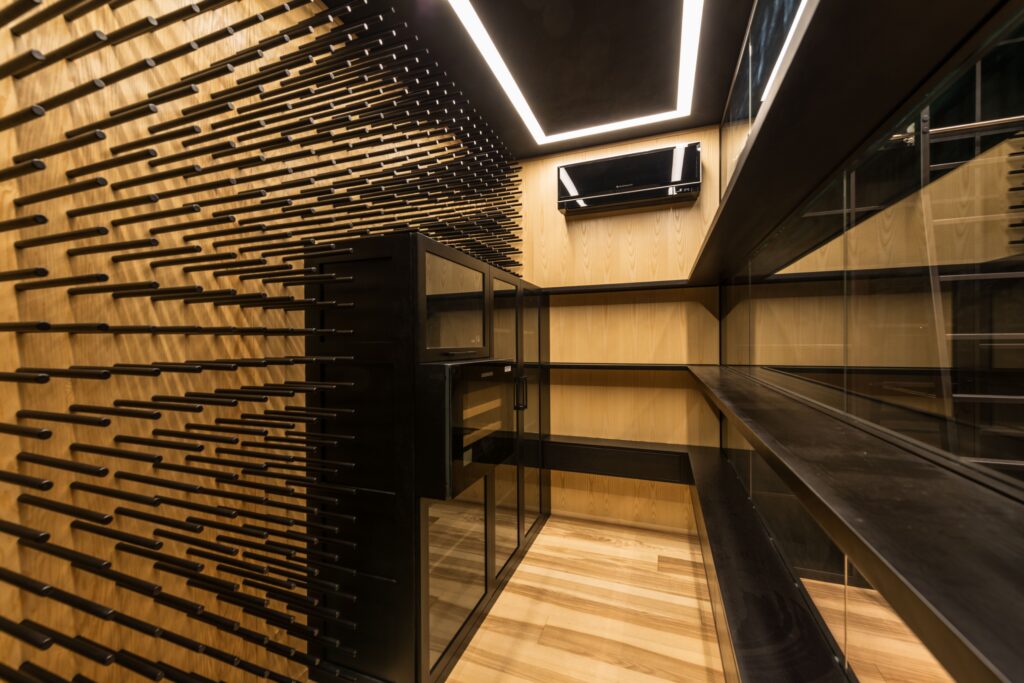
Like any refrigeration plant, a cellar system needs regular attention to perform at its best. Filters clog, coils gather dust, refrigerant charges drift, and drains block, and because the margins in a cellar are so fine, small losses matter more than in ordinary comfort cooling. An annual professional check through our servicing and maintenance programmes keeps temperatures true, humidity stable, and running costs down, and catches developing faults before they threaten the collection.
For commercial operators, restaurants, bars, and retailers, maintenance is even more critical, since equipment runs harder and downtime hits revenue directly. We support commercial heat pump and HVAC clients across Auckland with planned maintenance for exactly this reason.
Your wine deserves better than guesswork. Whether you are planning a new cellar, upgrading a cool room that has never quite worked, or protecting commercial stock, Varcoe brings 50 years of Auckland refrigeration expertise, licensed technicians, and a 12-month workmanship guarantee to every project.
Book your free wine cellar assessment and quote today, or call our team on 0800 088 888. Tell us about your space and your collection, and we will design a climate control solution that keeps every bottle exactly where it should be, for as long as you choose to wait.
Long-term storage is ideal at around 12 to 14 degrees Celsius with relative humidity between 55 and 75 percent. Stability matters as much as the number itself. A cellar that holds a steady 14 degrees is far better than one that swings between 10 and 18.
No. Standard comfort cooling equipment is not designed to hold rooms at cellar temperatures. It will struggle below about 16 to 18 degrees, dehumidify the air excessively, and wear out prematurely. Purpose-built cellar conditioning uses low-temperature refrigeration technology with humidity-aware control.
Almost any space can work, from a converted under-stair cupboard holding a few hundred bottles to a full basement room for thousands. What matters is insulation, vapour sealing, and correctly sized equipment for the volume. Small rooms are often trickier than large ones because heat gains are proportionally higher, which makes professional design even more valuable.
Costs vary with room size, construction condition, equipment type, and whether ducting or remote condensers are required. A compact self-contained system for a small domestic cellar sits at the lower end, while large ducted or split systems for commercial venues cost more. Varcoe provides free, no-obligation assessments and quotes so you know the numbers before committing.
Not if it is designed well. Split and ducted configurations place the compressor outside or in a plant space, leaving only quiet air movement in the cellar itself. Even self-contained units can be positioned and isolated to keep noise away from living areas. Noise expectations are part of the design conversation from day one.