Auckland Wide
Monday - Friday: 8.00am - 5.00pm

It’s a question that comes up every summer in Auckland. You’re too warm, you want to do something about it, and the portable air conditioner at Bunnings looks like a quick and affordable fix compared to a professional heat pump installation. So which one actually makes sense? This guide breaks down both options honestly so Auckland homeowners can make an informed call.
A portable air conditioner is a self-contained unit that sits on the floor, draws in room air, cools it, and exhausts hot air through a hose vented out a window or door. No installation required beyond setting it up and running the hose. It can be moved from room to room and packed away when not in use.
An installed heat pump is a split system permanently mounted to your wall, with an indoor unit connected via refrigerant lines to an outdoor unit. It heats and cools by moving heat rather than generating it, making it significantly more efficient than resistive heating or basic cooling units. Installation takes a few hours and requires a licensed technician.
Both cool a room. That’s largely where the similarity ends.
Auckland’s climate is the key variable here. Humid summers, cool winters, and the kind of damp cold that settles into a house and doesn’t leave it’s not a single-season problem. You need something that handles both ends of the spectrum well.
Portable air conditioners cool only. They have no heating function, which means you need a separate solution for winter entirely. If you buy a portable unit to get through summer, you still face the heating question come May.
Installed heat pumps handle both heating and cooling in one system, year-round. In heating mode they’re highly efficient, making them well suited to Auckland’s winter conditions. In cooling mode they outperform portable units significantly in terms of both capacity and consistency. A properly sized installed heat pump maintains a set temperature across the whole room; portable units tend to cool the air immediately around them but struggle with larger or open-plan spaces.
This is where the gap between the two options becomes most apparent.
Portable air conditioners are relatively inefficient. They draw significant power for the cooling output they produce, and because the hot exhaust hose runs through the same space you’re trying to cool, there’s inherent heat leakage that reduces effectiveness. Running a portable unit regularly through an Auckland summer adds up on your power bill.
Installed heat pumps work by moving heat rather than creating or destroying it. For every unit of electricity consumed, a good quality heat pump delivers significantly more heating or cooling output in return. Over a full Auckland year of heating and cooling, the running cost difference between a portable air conditioner and an installed heat pump is substantial. The higher upfront cost of an installed system is typically recovered through lower energy bills over time.
Portable units come with real-world inconveniences that aren’t obvious from the shop floor. The exhaust hose needs to vent outside, which means a window or door has to stay partially open while the unit runs. In Auckland’s humid summer that gap lets warm, moist air back in, which directly undermines what you’re trying to achieve. The units are also noisy, bulky, and need their water tanks drained regularly as they dehumidify the air.
An installed heat pump runs quietly, is operated by a remote or smartphone app, and requires no day-to-day management beyond adjusting the temperature. It’s fitted once and then simply works.
For renters, a portable unit may be the only realistic option if a landlord won’t permit an installation. For homeowners, there’s no practical reason to accept the compromises of a portable unit when an installed system performs significantly better in every measurable way.
The upfront cost difference is real. A decent portable air conditioner costs anywhere from $400 to $1,200. A professionally installed heat pump for a single room starts from around $3,000 to $4,500 all-in for a quality unit from a reputable brand. That’s a meaningful gap.
But the comparison changes when you factor in the full picture. A portable unit covers summer cooling only. An installed heat pump covers heating and cooling across the entire year, replacing what might otherwise be a separate and expensive heating solution. It also adds value to your property in a way a portable unit never could. And the running cost advantage of an installed system compounds year after year.
For most Auckland homeowners doing the full calculation, the installed heat pump is the more cost-effective choice over any period longer than a year or two. Varcoe has been helping Auckland homeowners work through exactly this kind of decision since 1975.
This is the one scenario where a portable unit has genuine merit. If you’re renting and your landlord hasn’t provided adequate heating or cooling, a portable air conditioner gives you something for summer with no installation required. The Healthy Homes Standards require landlords in New Zealand to provide a fixed heating device capable of heating the main living room to 18 degrees, so it’s worth knowing your rights as a tenant before investing in a portable unit as a long-term solution.
If you own your home, a portable air conditioner is rarely the right answer for anything beyond a very temporary, specific need.
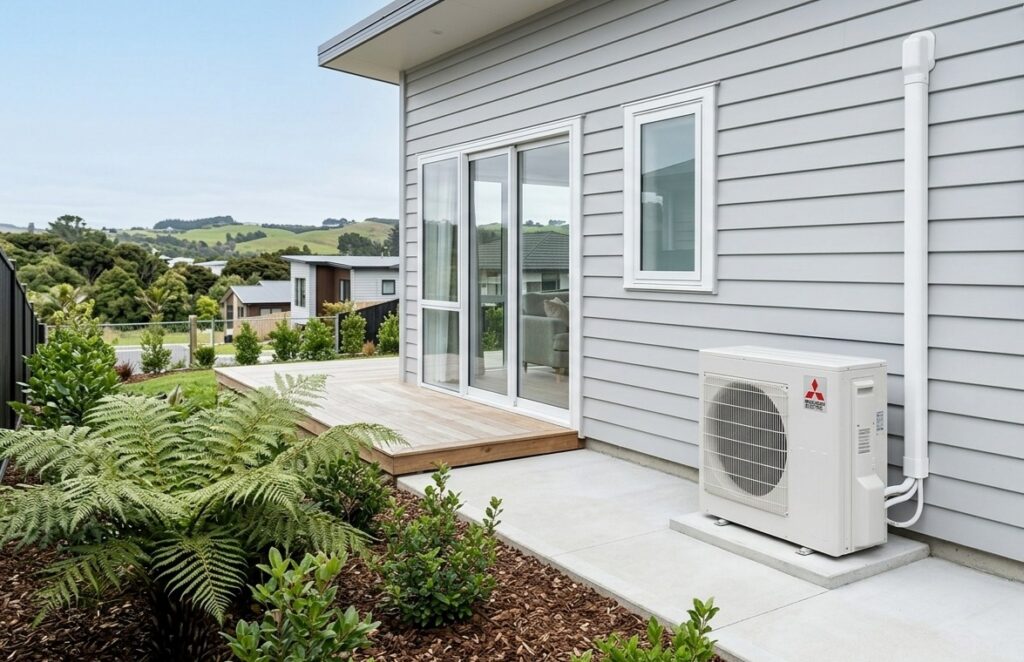
Not every installed heat pump is the same. The right type depends on your home’s layout and what you’re trying to achieve.
A single-split hi-wall unit is the standard choice for most Auckland rooms and open-plan living areas. For homes where you want climate control across multiple rooms without cluttering the exterior with several outdoor units, a multi-room heat pump system runs multiple indoor units from one outdoor unit. For whole-home comfort without visible units in each room, a ducted system distributes air invisibly through ceiling vents. Varcoe’s team will advise on which option fits your home during a free on-site assessment.
If you’re unsure what capacity you need, the Heat Pump Size Calculator gives a useful starting point before you call.
A portable air conditioner requires regular filter cleaning and water tank draining. Units typically last five to eight years with moderate use before performance degrades noticeably. There’s no professional servicing structure and no warranty coverage after the standard retail period.
A quality installed heat pump from a brand like Mitsubishi, Daikin, or Panasonic lasts 15 years or more with proper maintenance. Professional servicing every one to two years keeps the system running at peak efficiency and validates the manufacturer warranty. Varcoe’s servicing team covers all Auckland suburbs for routine maintenance and repairs on all makes and models.
For homeowners, the installed heat pump wins on every meaningful measure: performance, efficiency, year-round functionality, running costs, longevity, and property value. The higher upfront cost is the only argument in favour of the portable unit, and it’s an argument that weakens the longer you own your home.
Portable air conditioners make sense in one situation: you’re renting, your landlord won’t permit an installation, and you need something for summer. In every other scenario, an installed heat pump is the better investment.
Most portable air conditioners are cooling-only units. Some portable models marketed as heat pumps do offer a heating mode, but their heating efficiency is significantly lower than a properly installed split-system heat pump. For Auckland’s winter conditions, a portable heating function is rarely adequate as a primary heat source.
Yes, for most homeowners. The upfront cost of a single-room installed heat pump is recovered through lower running costs, and the system provides heating and cooling year-round replacing what might otherwise be two separate appliances. The key is correct sizing; a unit sized well for the space runs efficiently and keeps operating costs down.
A standard single-room installation typically takes 3 to 4 hours. A small, neat hole is drilled through the wall to run refrigerant lines, and brackets are secured to the interior and exterior walls. The site is left tidy and you receive a full operational walkthrough before the technician leaves. Most homeowners find it less disruptive than expected.
Yes. Any permanent installation requires landlord consent in a rental property. If consent isn’t granted, a portable unit may be your only option for the duration of that tenancy. It’s worth noting that under New Zealand’s Healthy Homes Standards, landlords are required to provide fixed heating in the main living area, so the conversation with your landlord about permanent heating is a reasonable one to have.
The right capacity depends on the room’s floor area, ceiling height, insulation quality, number of windows, and how the space is oriented. An undersized unit will run constantly without reaching the set temperature; an oversized one will short-cycle and use more energy than necessary. A qualified installer will assess your space and recommend the correct capacity before any purchase is made.
If you own your Auckland home and you’re still relying on a portable air conditioner, an installed heat pump will outperform it in every way that matters. Varcoe’s team will assess your space, recommend the right system, and have it installed and running the same day.
Get a free quote today or call 0800 088 888 Monday to Friday, 8am to 5pm.
This article is intended as a general guide for Auckland homeowners. System performance, running costs, and installation requirements vary depending on your specific property and chosen equipment. Contact Varcoe directly at varcoe.co.nz for advice tailored to your home.