Your Mitsubishi heat pump has stopped working and there’s a code on the display. Before you call anyone, it’s worth understanding what that code is actually telling you because some are simple self-fix situations, and others need a qualified technician on the same day. This guide covers the most common Mitsubishi error codes seen in New Zealand homes, what they mean, and what action to take.
Varcoe has been servicing Mitsubishi Electric heat pumps across Auckland since 1975. The team sees these faults regularly, and the information below reflects real-world patterns from the field.
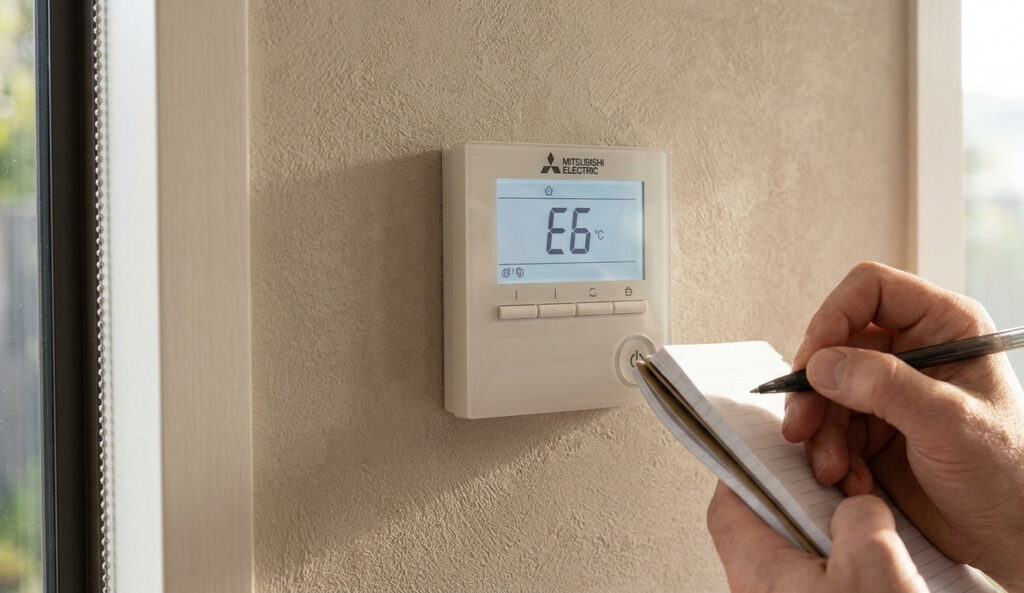
Most Mitsubishi systems use a combination of letters and numbers to flag faults. You can find the code by looking at the wall controller or remote display, counting the LED flashes on indoor or outdoor units, or checking your service manual. The letter prefix tells you roughly where the fault sits: E codes are generally communication-related, P codes are indoor unit or sensor faults, and U codes relate to the outdoor unit or compressor. Write down the exact code before doing anything else.
E6 – Communication Error Between Indoor and Outdoor Units
An E6 error code indicates a communication fault between the indoor and outdoor units. This could stem from improper wiring, a malfunctioning control board, or other connectivity issues that disrupt the communication flow. It’s one of the more common codes Varcoe’s technicians are called out for. Power cycle the system first, turn it off at the wall, wait five minutes, and restart. If E6 returns immediately, the fault is likely in the wiring or control board and needs professional diagnosis.
P1 – High Pressure Protection
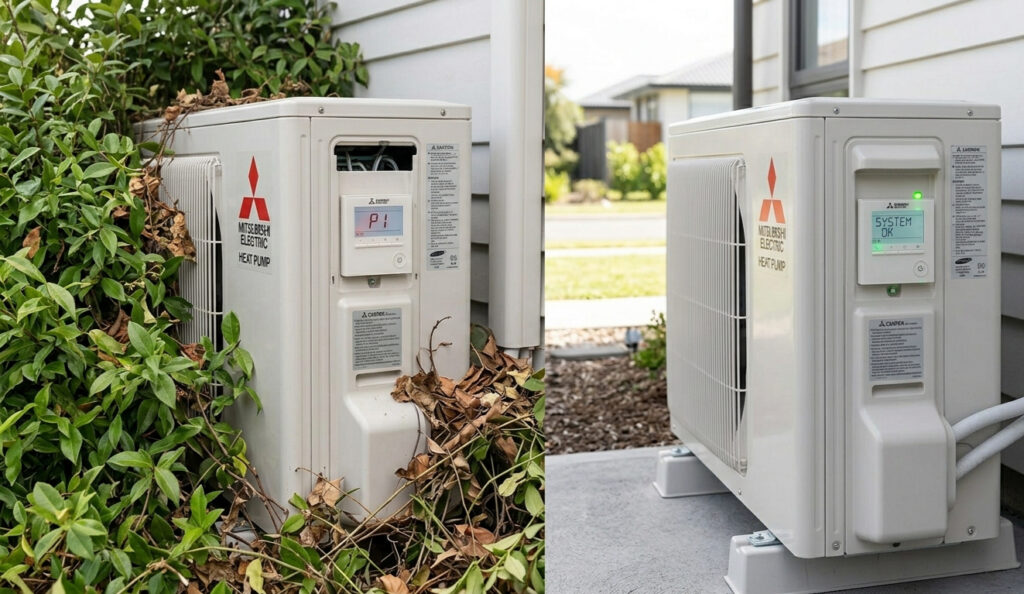
P1 error codes relate to high-pressure protection mode. If you see a P1 error code, it’s possible that your unit is experiencing issues like a dirty air filter, blockage in the outdoor unit, or even a refrigerant leak. Start by cleaning the indoor filters and checking that nothing is obstructing the outdoor unit overgrown plants, garden furniture, and stored items. If the outdoor unit is clear and filters are clean but P1 returns, a refrigerant issue is likely and a technician is needed.
P5 – Drain Fault
P5 indicates a drain issue clean the drain line and drain pump. This is one of the more straightforward faults. In Auckland’s humid climate, condensate drain lines can develop algae or debris blockages over time. Some homeowners can clear a simple blockage themselves, but if the drain pump itself is faulty, a technician will need to replace it. Water leaking from the indoor unit often accompanies this code.
P8 – Pipe Temperature Fault
P8 is a pipe temperature error often related to a defrost issue or thermistor fault. In winter, this can indicate the outdoor unit is struggling to defrost correctly. Some frost on the outdoor unit is entirely normal; heat pumps usually go into defrost mode automatically, but if the unit is completely frozen and not clearing, that’s a problem requiring professional attention. Never chip away at ice on the outdoor unit as this damages internal components. If P8 appears in summer or mild weather, the fault is more likely a thermistor sensor issue requiring a technician.
E7 – Outdoor Fan Motor Fault
The E7 error code points to an outdoor fan motor issue and requires a thorough inspection of the fan system, usually with the assistance of a professional. Check the outdoor unit for visible obstructions, leaves, debris, or anything that could be jamming the fan. If the fan is physically clear but the code persists, the motor or control board needs professional assessment.
E9 – Indoor Fan Motor Fault
The E9 error code signals a problem with the indoor fan motor, which might include a faulty motor, wiring issues, or a defective control board. This is not a DIY fix. Switch the unit off and call a technician. Running the system with a faulty indoor fan motor can cause further damage.
U1/U2 – Pressure Protection (Outdoor Unit)
U1 and U2 indicate pressure protection faults check refrigerant levels. These codes almost always require a technician, as refrigerant handling is a licensed trade in New Zealand. Running the unit with low refrigerant causes permanent compressor damage, so don’t attempt to keep the system going if either of these codes appear. Switch it off and book a service call.
U4 – Indoor/Outdoor Communication Error (Outdoor Unit)
Error codes that point to electrical complications like wiring problems associated with U4 are important to get a certified technician to handle, as they involve potentially dangerous situations. Don’t attempt to trace or repair wiring yourself. Power the system down and call a qualified technician.
If your mini split shows error codes, shut off power for five minutes to reset. If they reappear, contact a certified Mitsubishi service provider persistent errors often point to control board or refrigerant issues. A single appearance of many codes can be a momentary fault triggered by a power fluctuation or brief operating condition. A code that returns after a full power reset is telling you something more significant.
Before calling a technician, run through this list:
Remote batteries. A flat remote battery can cause the system to behave erratically or appear unresponsive. If the remote display is dim or blank, replace the batteries first.
Mode settings. Check whether the unit has been accidentally switched to Fan or Dry mode instead of Heat or Cool, or whether the temperature is set too low or too high. It happens more often than you’d think.
Indoor filters. A dirty air filter is a leading cause of reduced airflow and efficiency. When the filter is caked with dust and debris, it restricts the air that can pass through the system, reducing the amount of warm air circulated and causing the heat pump to work harder, increasing energy consumption and potentially leading to system damage. Remove the filters, check their condition, and clean or rinse them if needed. This takes five minutes and resolves a surprising number of call-outs.
Circuit breaker. A tripped circuit breaker or blown fuse is often the culprit when a system won’t start at all. Check your electrical switchboard to make sure the breaker is on.
Outdoor unit clearance. Check that the outdoor unit has clear airflow on all sides. Remove anything that’s been stored near it and clear any leaf or debris accumulation from around the base and grille.
Stop using the system and call a technician if you see any of the following:
The error code reappears after basic troubleshooting. You hear unusual or loud noises. You smell burning or strong electrical odours. There is excessive ice build-up on the outdoor unit that doesn’t clear. Water is consistently leaking from the indoor unit.
Error codes are designed to protect the electrical components by shutting down when something’s wrong. A small problem now like a clogged drain line or sensor fault can become a major repair if ignored.
Varcoe’s Servicing and Maintenance team services all Mitsubishi Electric models across Auckland, with same-day availability where possible. Their technicians are manufacturer-certified, which means any work done won’t affect your warranty.
An estimated 90% of all heat pump failures are due to a neglected cleaning and maintenance schedule. Most error codes Varcoe’s team attends to are preventable through regular professional servicing. A yearly service includes filter cleaning, coil inspection, refrigerant pressure check, drain line clearance, and electrical connection testing the combination of checks that catches small issues before they become error codes at 7pm on a winter evening.
Can I reset a Mitsubishi heat pump error code myself?
Yes, power the system off at the wall, wait five minutes, and restart. If the same error code returns after a full reset, the underlying fault is still present and a technician is needed. Repeated resets without addressing the cause can cause further damage.
What does a flashing light on my Mitsubishi indoor unit mean?
Mitsubishi units use LED flash patterns on indoor and outdoor units to communicate fault codes count the green and red flash sequences and refer to your user manual or a qualified technician to interpret the pattern. The number and colour of flashes correspond to specific fault codes.
My Mitsubishi shows an error code in winter but not in summer is that normal?
Some codes, particularly P8 (pipe temperature fault), are more likely to appear in cold weather due to defrost cycle behaviour. If the code clears on its own after the outdoor unit defrosts and the system resumes normal operation, it may be a minor cold-weather event. If it recurs regularly in winter, have a technician check the defrost cycle and outdoor unit condition.
Is it safe to keep using the heat pump if an error code appears?
It depends on the code. Some codes like P5 (drain fault) are less immediately dangerous, while others like U1/U2 (pressure protection) indicate conditions that can cause permanent compressor damage if the system continues to run. When in doubt, switch the unit off and call a technician rather than running it through an active fault.
How long does a Mitsubishi heat pump repair typically take?
For most common faults sensor replacements, drain clearing, minor electrical faults a qualified technician can diagnose and repair in a single visit. More complex issues involving compressor or control board replacement take longer depending on parts availability. Varcoe’s technicians carry common parts for Mitsubishi Electric systems.
Varcoe’s technicians are Mitsubishi Electric manufacturer-certified and service all Auckland suburbs from the North Shore to South Auckland, East to West. Same-day service is available where possible.
Book a service call today or call 0800 088 888 Monday to Friday, 8am to 5pm.
This article is intended as a general reference guide. Error code behaviour varies by model and system configuration. Always refer to your unit’s manual and contact a qualified technician for diagnosis. Do not attempt to repair refrigerant systems or internal electrical components yourself.