You have decided to put a heat pump in the room, which is the easy part. Then the quotes come back mentioning high wall units, floor consoles and ceiling cassettes, and suddenly there is a decision you did not know you had to make. The good news is that this one is genuinely simple once you know what each type is for, because they are not better or worse than each other, they just suit different rooms.
Here is what each of the three main indoor unit styles does well, where each one falls down, and how to pick the right one for your space.
A high wall unit is the right choice for most rooms, and it is the most affordable and efficient. A floor console suits rooms with no usable wall space, or where you are replacing an old fireplace or floor heater. A ceiling cassette is for open-plan spaces and rooms where you want the unit to all but disappear. If you match the type to the room rather than to a price, you will be happy for years.
The high wall unit is the familiar one, mounted up near the ceiling on a wall. It is the most popular style in New Zealand, and for good reason. Sitting up high, it throws warm air out and down across the whole room, which is the most effective way to heat a space, so it tends to be the most efficient of the three. It is also the cheapest to buy and the quickest to install, usually going in within a few hours.
The trade off is simply that you can see it. If a unit on the wall does not bother you, and you have the wall space up high for it, the high wall is almost always the sensible pick for a bedroom, lounge or office.
A floor console sits at floor level instead of up on the wall, either standing freely on a base or semi-recessed into the wall for a more built-in look. It shines in a few specific situations. If you are replacing an old fireplace or a night-store heater, a console drops neatly into the same footprint, which makes the retrofit clean and straightforward. If the room has no usable high wall, because it is all windows, doors and furniture, a console solves that problem. And because the filters sit at floor level, they are easy to reach and clean yourself, with no climbing on a chair.
The compromises are worth knowing. A console has to push air up and then out, rather than down from above, so it distributes heat a little more slowly than a high wall unit. And it takes up floor space, which matters in a small room. For the right room, though, especially a fireplace replacement, it is the obvious choice.
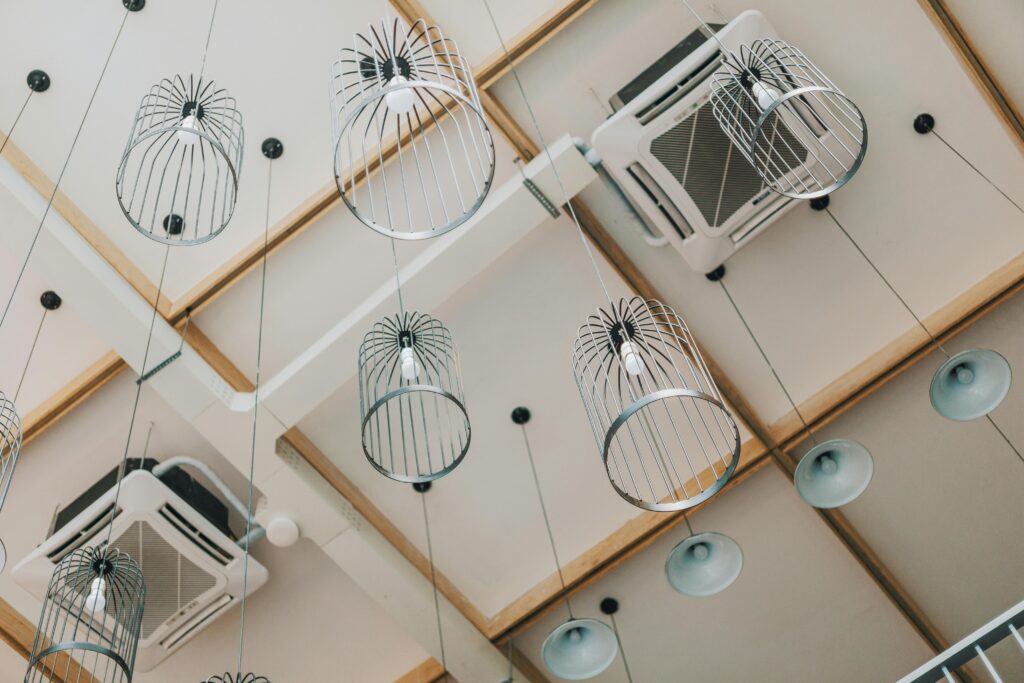
A ceiling cassette is recessed up into the ceiling cavity, so all you see is a slim, flat grille sitting flush with the ceiling. It is the choice for people who care how the room looks, which is why architects and interior designers reach for them, and why they are common in offices, retail spaces and open-plan living areas.
Beyond the clean look, a cassette pushes air out in four directions, which spreads heat evenly across a room with none of the drafts or cold corners you can get from a single wall unit. They also tend to be very quiet. The catch is cost and installation. A cassette costs more upfront, the install takes longer because it involves cutting into and working with the ceiling, and you need a ceiling cavity that can take it. When the look matters, that premium is usually money well spent.
| High wall | Floor console | Ceiling cassette | |
| Best for | Most rooms, best value | Fireplace replacements, no wall space | Open-plan, design-led rooms |
| Look | Visible on the wall | Visible at floor level | Nearly invisible, flush grille |
| Air distribution | Excellent, from above | Good, pushes up then out | Excellent, four directions |
| Cost | Lowest | Middle | Highest |
| Install | Fastest | Straightforward | Longest, works into the ceiling |
In practice it usually comes down to the room. A bedroom or lounge with normal wall space is a high wall job. A lounge where you are pulling out a tired fireplace is a floor console. An open-plan kitchen and living area, or a room where you simply do not want to see a unit, is a ceiling cassette. And you are not locked into one type across the house. It is perfectly normal to run a high wall in the living room, a console in a bedroom, and a cassette somewhere the look matters, all in the same home.
If you are weighing up heating several rooms at once, it is also worth knowing that a single ducted whole home system is a fourth option that hides everything and heats the lot, though it is the premium route and best suited to new builds.
One thing does not change with the style you pick, and that is capacity. A beautifully chosen cassette that is too small for the room will still struggle, and an oversized console will still short cycle and waste power. Get the kilowatts right for the room first, then choose the type that suits the space. Our heat pump size calculator gives you a quick estimate, and an in-home assessment confirms it properly by looking at your insulation, windows and layout.
Two small day to day differences are worth a thought. On cleaning, a floor console wins for convenience, because its filters sit at floor level and you can slide them out and rinse them without a ladder, whereas a high wall or a cassette means reaching up. On noise, all three are quiet on modern units, but cassettes in particular are known for being whisper quiet, which is part of why they suit bedrooms and offices where you do not want to hear anything running overnight. None of this should override matching the type to the room, but if two options are close for your space, these details can tip the decision.
Choosing between a high wall, a console and a cassette is easy once someone has seen the actual room, the wall space, the ceiling and the layout. That is exactly what an in-home assessment is for.
Varcoe has installed more than 20,000 systems across Auckland since 1975, and we fit all three types, so we have no reason to push one over another. We will look at your room and recommend the style that genuinely suits it, then size it correctly. Book a free in-home assessment, call us on 0800 088 888, or email info@varcoe.co.nz, and we will help you choose with confidence.
A high wall unit mounts up near the ceiling and throws air down across the room, making it efficient, affordable and quick to install. A floor console sits at floor level, suits rooms with no wall space or fireplace replacements, and has easy to reach filters, but distributes air a little more slowly and takes up floor space.
If the look of the room matters to you, yes. A cassette is recessed into the ceiling so only a slim grille shows, spreads air evenly in four directions and runs quietly. It costs more and takes longer to install than a wall unit, so it is best where appearance is a priority, such as open-plan or design-led rooms.
A high wall unit is usually best for a bedroom, because it is efficient, affordable and quiet. A floor console works well if there is no suitable wall or you are replacing a floor heater, and a cassette suits a bedroom where you want the unit hidden.
Yes. It is common to use a high wall in the living room, a floor console in a bedroom and a ceiling cassette where the look matters. You choose the best type room by room.
Size and efficiency matter more than type, but a high wall unit’s air distribution from above tends to be slightly more efficient than a floor console pushing air upward. The bigger lever is choosing the right capacity and a good efficiency rating.
We look at the room, the wall space and the ceiling, then recommend the style that genuinely fits and size it right.