Most people give the indoor unit all their attention, since that is the part on the wall, the part they set and feel. But the outdoor unit, the box sitting outside against the house, is doing half the work and is just as important to how well your heat pump performs. It is also the part most exposed to weather, leaves and neglect. Understanding what the outdoor unit does, and giving it a little basic care and the right space to breathe, keeps your whole system running efficiently and lasting longer. Here is what you need to know.
The outdoor unit is where your heat pump exchanges heat with the outside air, releasing heat in cooling mode and absorbing it in heating mode, using a coil, a fan and the compressor. For it to work efficiently it needs good airflow, so keep it clear of leaves, plants and clutter with space around it, keep the coil and fan clean, and make sure it has proper clearance and a stable base. Poor placement or a blocked, dirty outdoor unit is one of the most common causes of weak performance and faults.
Here is what the outdoor unit does, how to care for it, and why its placement matters so much.
The outdoor unit is the heart of the heat-exchange process that makes a heat pump work. A heat pump does not create heat, it moves it, and the outdoor unit is where that heat is swapped with the outside air. Inside the outdoor box are the key components: a coil, a large fan, and the compressor that drives the refrigerant around the system.
In heating mode, the outdoor unit absorbs heat from the outside air, even on a cold day there is heat to extract, and the fan draws air across the coil to capture it, sending it inside to warm your room. In cooling mode the process reverses, and the outdoor unit releases the heat pulled from inside your home out into the air. The fan is constantly moving large volumes of air across the coil to make this exchange happen. This is why airflow is everything for the outdoor unit: if it cannot breathe freely, it cannot exchange heat efficiently, and the whole system struggles and works harder.
Because the outdoor unit’s performance depends on free airflow and sensible positioning, and a poorly placed unit is handicapped from day one. Here is what good and bad placement look like.
| Do | Avoid |
| Plenty of clear space around the unit for airflow | Cramming it into a tight nook or boxing it in |
| A shaded or sheltered spot where practical | Blazing all-day sun that makes cooling work harder |
| A solid, level base or wall bracket | An unstable base that adds vibration and noise |
| Clearance from fences, walls and plants | Shrubs or fences right up against the coil |
| A spot where noise will not disturb bedrooms or neighbours | Directly under a bedroom window |
| Good drainage below for condensate and defrost melt | A spot where water pools or drains badly |
The single biggest principle is clearance for airflow. The unit needs room around the coil and in front of the fan to draw and expel air freely, so boxing it in, surrounding it with plants, or pushing it hard against a wall all choke its performance. Placement also affects noise, drainage and how easy the unit is to service, which is why getting it right at installation matters so much, because moving it later is far harder than placing it well at the start.
The outdoor unit is low-maintenance, but it is not no-maintenance, and a little regular care keeps it efficient. The main job is keeping it clear and clean.
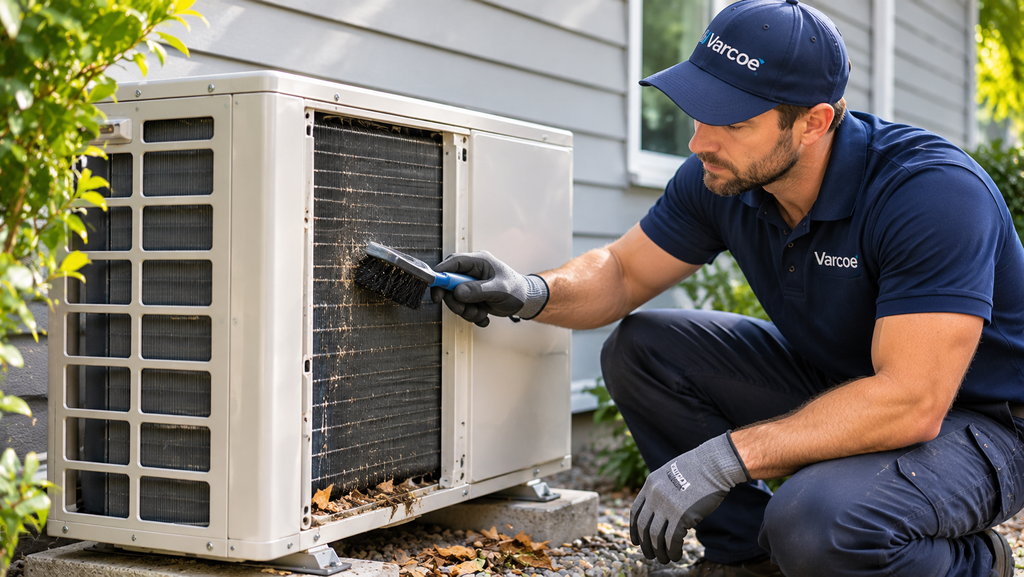
Keep the area around it free of leaves, grass clippings, weeds and clutter, since anything that blocks airflow forces the unit to work harder. Trim back any plants or shrubs that are growing towards it to maintain clearance. Gently clear leaves and debris off and around the coil and fan guard, and keep the coil itself clean, as a coil clogged with dust, pollen and grime cannot exchange heat properly. After autumn especially, clear away the leaves that collect around and inside the base. Check that the unit is sitting level and stable, since a unit that has shifted can vibrate and run noisily. And make sure the condensate and defrost water draining from it has somewhere to go rather than pooling. These simple checks, alongside the indoor filter cleaning covered in our maintenance guide, keep the whole system healthy. The deeper cleaning of the coil and internal components is part of a professional service.
Yes, and knowing what is normal saves needless worry. It is completely normal for the outdoor unit to produce water, dripping or pooling beneath it, especially in winter, because that is melt-water from the defrost cycle clearing frost off the coil, or condensate in cooling mode. A puddle under the outdoor unit is usually nothing to worry about. It is also normal for the unit to steam or give off a cloud of vapour during a winter defrost cycle, and to briefly change its sound as it switches modes. What is not normal is loud rattling, grinding or screeching, which suggests a loose part or a failing fan or component, or the unit becoming significantly louder than usual, both of which are worth having checked. Learning the difference between the normal hum and defrost behaviour and genuine warning sounds helps you catch real problems early without panicking over routine operation.
Very much so, on both counts. On efficiency, a clean, well-placed outdoor unit with free airflow exchanges heat easily and runs efficiently, while a dirty, blocked or badly placed one makes the whole system work harder for the same result, pushing up running costs and wear. On noise, the outdoor unit is the part that hums, so its placement and condition directly affect how much you and your neighbours hear it. A stable base, good clearance and a sensible location away from bedroom windows keep it quiet, while a unit that has worked loose or is straining against poor airflow gets louder. Quality also plays a part, as quieter, more efficient outdoor units are one of the things that separate the better makes, which our comparison of the best heat pump brands looks at. Looking after the outdoor unit is, in short, looking after the efficiency, quiet and lifespan of the entire heat pump.
The outdoor unit does half the work of your heat pump, and it asks for very little in return: room to breathe, a clear and clean coil, a stable base, and the occasional sweep of leaves. Give it that, place it well from the start, and it will exchange heat efficiently, run quietly, and last for years, keeping the whole system performing at its best.
Varcoe has placed and serviced heat pump outdoor units across Auckland since 1975, more than 20,000 installs, so we know exactly where a unit belongs and how to keep it running well. For placement advice, a service, or any concern about your outdoor unit, get in touch, call 0800 088 888, or email info@varcoe.co.nz.
It is where the heat pump exchanges heat with the outside air. Using a coil, a fan and the compressor, it absorbs heat from the air in heating mode and releases heat in cooling mode. The fan constantly moves air across the coil to make this exchange, which is why free airflow around the unit is so important.
It needs clear space around the coil and in front of the fan so it can draw and expel air freely, rather than being boxed in, pushed hard against a wall, or surrounded by plants. Good clearance is essential for efficient heat exchange, so follow the manufacturer’s spacing guidance and keep the surroundings clear.
Keep it clear of leaves, clippings, weeds and clutter, trim back nearby plants, and gently remove debris from around the coil and fan guard. Check it is sitting level and that water drains away rather than pooling. Leave deeper coil and internal cleaning to a professional service, and keep up with indoor filter cleaning too.
Usually it is normal. In winter it is melt-water from the defrost cycle clearing frost off the coil, and in cooling mode it is condensate. A puddle under the outdoor unit is generally nothing to worry about. Only water coming from the indoor unit into the room signals a drainage problem that needs attention.
Somewhere with plenty of airflow and clearance, on a solid level base or bracket, ideally sheltered from harsh all-day sun, with good drainage, and away from bedroom windows and neighbours to limit noise. Avoid cramped nooks and spots blocked by fences or shrubs. Getting placement right at installation is important, as moving it later is difficult.
A steady hum is normal, as is steam or vapour during a winter defrost cycle and a brief change in sound when the unit switches modes. What is not normal is loud rattling, grinding or screeching, or the unit becoming much louder than usual, which can indicate a loose or failing part and is worth having checked.
We place, service and repair heat pump outdoor units across Auckland, keeping your whole system efficient and quiet.