It’s a cold Auckland evening, you’ve turned the heat pump on, and the room isn’t warming up. Before you call a technician, there’s a practical sequence of checks worth working through because a significant number of heat pump call-outs turn out to be straightforward issues a homeowner can resolve in minutes. This guide covers those checks in order, tells you what the likely cause is for each symptom, and is clear about when it’s time to stop troubleshooting and pick up the phone.
Many homeowners call technicians for a unit that turns out to be a setting issue. It’s always worth checking first.
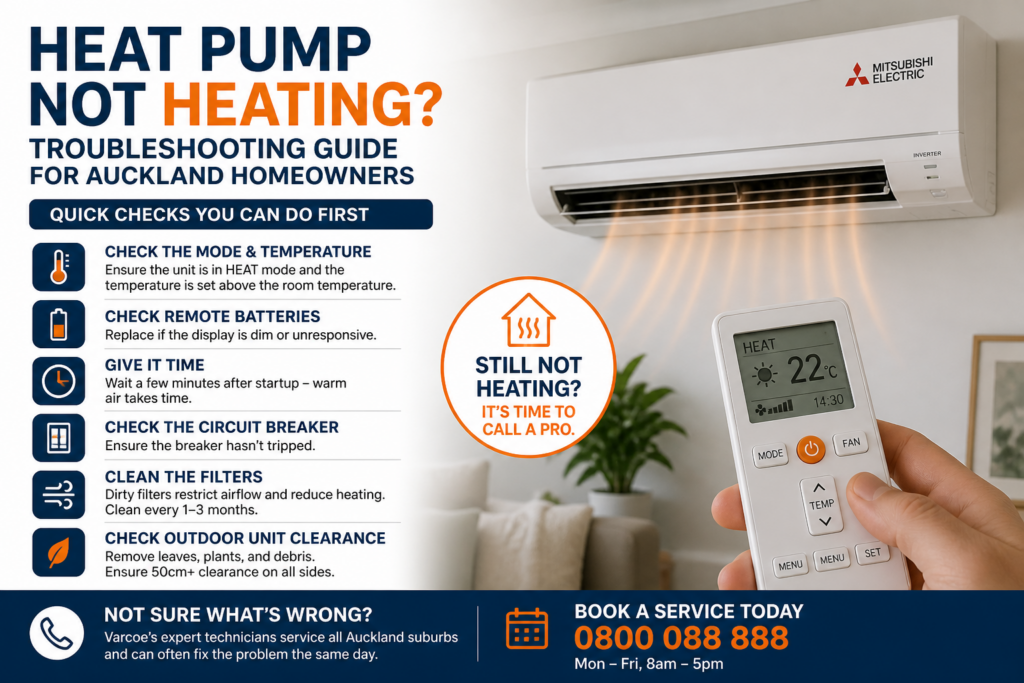
Check the mode. Has the unit been accidentally switched to Fan or Dry mode instead of Heat? Or is the temperature set too low? It happens more often than you’d think. Another common mistake is setting the fan to Auto, which can cause the unit to cycle on and off, making it feel ineffective. Try setting it to a constant low or medium speed.
Check the remote batteries. If the remote screen is dim or unresponsive, the batteries are the first thing to replace. A flat battery can prevent mode changes from being transmitted correctly.
Give it time. A heat pump is not an instant-on heater. It takes a few minutes after startup before warm air begins flowing. If you’ve just turned it on, wait five minutes before concluding there’s a problem.
Check the circuit breaker. A tripped circuit breaker or blown fuse is often the culprit when a unit won’t start at all. Check your electrical switchboard to make sure the circuit breaker is on.
This is the number one call-out heat pump technicians receive across Auckland. The unit is clearly operating, the display is on, the fan is running but the air coming out is lukewarm or simply not doing the job.
Dirty filters. This is the single most common cause. A dirty air filter is a leading cause of reduced airflow and efficiency. When the filter is caked with dust and debris, it restricts the air that can pass through the system, not only reducing the amount of warm air circulated but also causing the heat pump to work harder and increasing energy consumption.
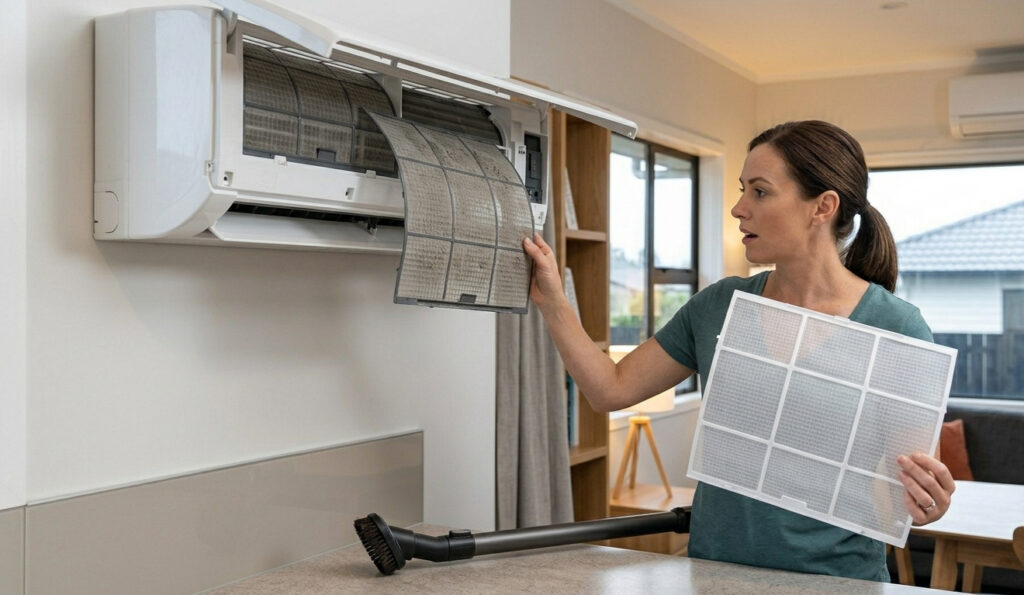
Cleaning filters takes five minutes: open the front panel of the indoor unit, remove the mesh filters, vacuum or rinse them gently, allow them to dry completely, and reinstall. It’s recommended to clean filters every one to three months, or more frequently if you have pets or allergies. The performance difference after a filter clean is often immediately noticeable.
Blocked outdoor unit. The outdoor unit needs clear airflow to extract heat from the air. Check that overgrown plants, stored items, or debris aren’t restricting it. Clear at least half a metre of space around the unit on all sides. In autumn and winter, leaf accumulation around the base is a common and easily fixed issue.
Defrost cycle. In Auckland winters, some frost formation on the outdoor unit is completely normal. The heat pump enters a defrost cycle automatically, temporarily blowing cooler air while it clears the frost. If the unit is producing cool air for a short period then returns to normal heating, this is likely what’s happening rather than a fault. However, if the outdoor unit is completely frozen and not clearing, that is a problem requiring professional attention. Never chip away at ice on the outdoor unit as this damages internal components.
The room is too large for the unit. If you’ve recently opened up a room, removed a wall, or started using the heat pump to heat a larger area than it was sized for, it will run continuously without reaching the set temperature. This is a sizing issue rather than a fault; the Heat Pump Size Calculator helps clarify what capacity your space actually needs.
If the indoor unit shows no signs of life no display, no response to the remote, no sound:
Check the circuit breaker in your switchboard. If it has tripped, reset it once. If it trips again immediately, there’s an electrical fault and you need a technician do not keep resetting.
Check the remote batteries. If the display on the remote is blank or very faint, replace the batteries before assuming a unit fault.
Check that the unit isn’t in a timer mode that has set it to turn off. Some units are set up with weekly timers that homeowners forget about.
If the unit has power but shows an error code on the display, refer to Varcoe’s Heat Pump Servicing team for a diagnosis, or see the Mitsubishi error code guide for code-specific guidance.
Unusual noises coming from your heat pump are often a sign of a specific issue. Rattling sounds may indicate loose screws or panels that need to be tightened. Hissing sounds can point to a refrigerant leak, which not only affects performance but can also be hazardous.
A quiet clicking when the unit starts or stops is normal. So is a gentle gurgling as refrigerant moves through the system. What isn’t normal: grinding, squealing, persistent rattling, or hissing. If you hear buzzing, hissing, or grinding, switch off the system and call for help. Don’t wait until it breaks completely.
If water is dripping from the indoor unit, the most common cause is a blocked drain pipe. Heat pumps remove moisture from the air when cooling, and if the water can’t drain properly, it leaks indoors. A regular service usually includes clearing this out. In Auckland’s humid climate, condensate drain blockages are particularly common. If water is dripping consistently rather than occasionally, switch the unit off and book a service call before ceiling or wall damage occurs.
If your power bill has increased and you suspect the heat pump, it could be working harder than usual due to blocked filters, degraded refrigerant charge, or general wear and tear. A well-maintained heat pump runs efficiently; one that’s been neglected works harder for the same output and shows it on your bill. The fix is usually a professional service rather than a repair.
Auckland’s climate creates a few specific patterns worth knowing about.
Coastal properties face accelerated corrosion on outdoor units from salt air. If your home is within a few kilometres of the coast, the outdoor unit coils are more likely to degrade over time, reducing efficiency. Annual servicing matters more in these locations, and Varcoe’s team can assess coil condition during a routine service.
Auckland’s humid summers mean condensate drain lines work hard through the warmer months. A blockage that causes water leakage in December is often the result of a drain that needed clearing months earlier. Scheduling a service in spring before the cooling season starts prevents this.
Contact a technician if the most common causes include low refrigerant levels, a faulty reversing valve, or a blocked outdoor unit and the problem persists after basic checks. If the unit runs without producing warm air and simple fixes haven’t worked, you need a qualified technician to diagnose the issue. Running a heat pump with low refrigerant can cause permanent compressor damage.
Call Varcoe’s servicing team if:
The problem hasn’t been resolved after cleaning filters and checking settings. You hear grinding, hissing, or squealing. Water is leaking from the indoor unit. The outdoor unit is frozen solid and not clearing. The system is showing an error code that returns after a reset. Your power bill has spiked without a change in usage.
An estimated 90% of all heat pump failures are due to a neglected cleaning and maintenance schedule. Most of the problems in this guide are either prevented by regular servicing or caught early enough during a routine check that they never become an emergency call-out.
Why is my heat pump blowing cold air in heating mode?
A heat pump blowing cold air when set to heat mode often points to a defrost cycle running normally, low refrigerant charge, or a faulty compressor. In colder weather, brief cool air during a defrost cycle is normal. If it persists, do not ignore it running a heat pump with low refrigerant can cause permanent compressor damage. Call a technician if the cold air continues beyond a few minutes.
How often should I clean my heat pump filters in Auckland?
Every one to three months for most Auckland homes. More frequently if you have pets, live near a dusty road, or run the system heavily through summer and winter. Filter cleaning is the single most effective maintenance task homeowners can do themselves to maintain performance and prevent call-outs.
My heat pump is running constantly but the room never reaches temperature. What’s wrong?
Frequent cycling or an inability to reach the set temperature can indicate a dirty filter restricting airflow, an incorrectly sized unit for the space, or a thermostat issue. It can also indicate low refrigerant, a slow leak that reduces heating capacity over months. Clean the filters first; if the problem persists, book a service call.
Is it normal for the outdoor unit to have ice on it in winter?
Some frost formation during cold weather is normal and the system will defrost automatically. A thin layer of frost that clears periodically is not a problem. A solid block of ice that isn’t clearing, or ice forming on the indoor unit, indicates a fault that needs professional attention.
How much does a heat pump service call cost in Auckland?
Contact Varcoe directly for current pricing. A standard service covers filter cleaning, coil inspection, refrigerant pressure check, drain line check, and electrical testing. Any additional repairs identified during the service are quoted separately before work proceeds.
Rather than guessing, Varcoe’s technicians can diagnose the issue accurately in a single visit and in most cases, resolve it the same day. The team covers every Auckland suburb and services all major heat pump brands.
Book a service or repair or call 0800 088 888 Monday to Friday, 8am to 5pm.
This guide is intended for general troubleshooting reference only. Do not attempt to service refrigerant systems, internal coils, or electrical components yourself; these require a licensed technician under New Zealand regulations.