You’ve walked into your living room, hit the remote, and something’s wrong. The unit on your wall is flashing a light that doesn’t normally flash, or a sequence you’ve never seen before. Maybe nothing is happening at all, or the system shut itself off mid-cycle. Now you’re staring at the Daikin trying to figure out whether this is a quick fix or a call-the-technician situation.
Here’s the good news: those flashing lights and error codes aren’t random. Your Daikin heat pump is trying to tell you something specific, and understanding what it’s saying can save you both time and money. This guide covers the most common Daikin error codes, what the different flashing patterns mean, what you can safely check yourself, and when to stop experimenting and call a professional.
Modern Daikin heat pumps have built-in diagnostic systems that monitor dozens of operating parameters in real time refrigerant pressure, temperature sensors, electrical connections, airflow, drainage, and more. When something falls outside normal operating ranges, the system flags the fault and often shuts down to prevent damage.
This is actually a good thing. A heat pump that silently pushes through a fault can end up with a catastrophically damaged compressor, a repair that costs far more than whatever the original issue was. The flashing lights and codes are the system protecting itself.
The challenge is that Daikin uses different code formats across its product range, and the specific meaning of any given code depends on your model. That said, there are common patterns and the most frequently seen codes appear across many units.
On most Daikin residential units, fault codes appear in one of two ways:
On the remote control display. If your remote shows a two-character code (a letter followed by a number, such as A1, U4, or E3), that’s your error code. On some models, holding the Cancel button for five seconds will trigger the remote to retrieve and display the current fault code stored in the indoor unit. You’ll hear a beep and the code will flash in the temperature display section.
Via the operation lamp flash pattern. On units without a display remote, the indoor unit’s operation lamp (usually green) flashes in a pattern. Count the number of flashes before the pause, then count after the pause. These two numbers together identify the fault. For example, a pattern of seven flashes, pause, two flashes typically indicates a specific fault category; your model’s manual will decode the exact meaning.
A yellow or orange “alarm” light on the indoor unit indicates a fault has been detected, regardless of whether the unit is running or has shut down.
An A1 code points to a problem with the printed circuit board inside the indoor unit. This can be triggered by a power surge, component failure, or in some cases a temporary electrical issue that resolves with a reset. Before calling a technician, try a full power reset: switch the heat pump off at the wall isolator (not just the remote), wait 30 seconds, and power it back on. If the A1 returns immediately after a reset, the control board needs professional inspection; this is not a DIY repair.
These codes indicate that one of the temperature sensors in the indoor unit heat exchanger is reading outside expected parameters or has failed. The sensor itself is a relatively inexpensive component, but accessing and replacing it requires a qualified technician. A C4 or C9 that persists after a reset needs a service call.
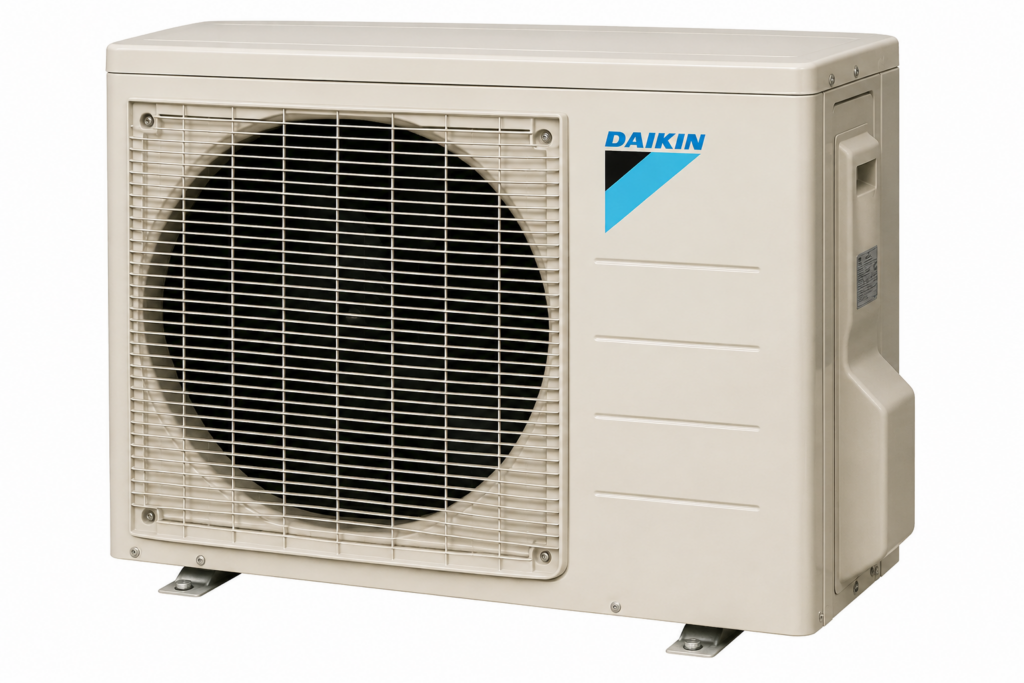
An E3 means the refrigerant pressure on the high-pressure side of the system has exceeded safe limits, triggering a protective shutdown. Common causes include a blocked or dirty outdoor unit (leaves, debris, restricted airflow), the outdoor unit being in an enclosed space with insufficient ventilation, or an actual refrigerant system issue. Check whether the outdoor unit has clear space around it and whether the fins are visibly dirty or blocked. If the outdoor unit appears clear and the error persists, call a technician refrigerant pressure issues require professional diagnosis.
This code indicates the outdoor unit’s fan motor is not operating correctly. It may have stopped, is running slower than expected, or a sensor monitoring it has failed. This is one to address promptly: the outdoor unit fan is critical for heat exchange, and running the system with a fan fault can cause compressor damage. Don’t continue using the heat pump with an E7 code book a heat pump service promptly.
An F3 code means the refrigerant discharge temperature (the temperature of the refrigerant leaving the compressor) is too high. This can indicate low refrigerant charge, a blockage in the refrigerant circuit, or a dirty system running harder than it should. Low refrigerant is one of the more common causes and it’s worth knowing that refrigerant doesn’t “run out” on its own; if charge is low, there’s a leak somewhere that also needs to be found and fixed. This is a fault that needs a certified refrigeration technician.
The H9 code flags a problem with the outdoor temperature sensor. On its own, this often won’t prevent operation, but it can cause performance issues because the system can’t accurately read ambient conditions. A reset sometimes clears intermittent sensor faults. If H9 persists, it’s a relatively straightforward repair for a technician.
A U4 code means the indoor and outdoor units have lost communication with each other. This can be caused by a wiring issue, a problem with one of the PCBs, or a power supply issue. Check that both the indoor and outdoor units have power. If the outdoor unit’s power supply has tripped at the switchboard, reset it and see if communication restores. Persistent U4 codes after checking power require a technician to inspect the communication wiring and circuit boards.
For Daikin units that use lamp flash patterns rather than alphanumeric codes, the operation lamp on the indoor unit communicates faults through sequences. Here’s how to interpret them:
The lamp flashes a set number of times, pauses, then repeats. Count the flashes in the first group (this is the “tens” position of the code) and the flashes in the second group (the “units” position). Combine them: six flashes then three flashes = code 63.
The most reliable reference for your specific unit is the installation manual or service manual both are typically available as PDF downloads from Daikin’s website using your model number, which is printed on the specification plate on the side of the indoor unit.
Common flash-pattern fault categories across Daikin residential units:
Again, your model-specific manual is the definitive reference.
Before calling a technician, there are several things worth checking not because you should attempt repairs yourself, but because they can save you a service call fee if the issue turns out to be simple.
Clean the air filter. A clogged filter is one of the most common triggers for faults and performance issues. On most Daikin units, the filter is accessible by opening the front panel of the indoor unit. If it’s visibly dirty or grey, clean it under a tap, let it dry fully, and refit it. This takes five minutes and sometimes resolves apparent faults related to airflow sensors.
Check the outdoor unit for blockages. Walk around the outdoor unit and check that nothing is obstructing airflow leaves, overgrown plants, furniture, bins placed nearby. The unit needs clear space on all sides for proper operation.
Try a power reset. Switch off at the wall isolator (not just the remote), wait 30 seconds, and restart. Some transient faults particularly communication errors and sensor faults after a power fluctuation resolve with a reset. If the code returns immediately, proceed to calling a technician.
Check the switchboard. If the heat pump has lost power entirely, check whether a circuit breaker has tripped. Reset it if so. If the breaker trips again when the heat pump starts, there’s an electrical fault that needs professional attention. Don’t keep resetting it.
Note down what the unit was doing when the fault occurred. Was it heating or cooling? What was the outdoor temperature? How long has it been running? This information is genuinely useful to a technician and can speed up diagnosis.
Some situations require immediate professional attention, and pushing through them risks expensive damage:
For Daikin units specifically, Varcoe’s technicians are certified and experienced with the full Daikin product range available in New Zealand. A Daikin heat pump service from a qualified Auckland technician will include a proper diagnosis with the right tools, not just a reset and a guess.
The majority of heat pump faults that generate error codes are either directly caused or made more likely by insufficient maintenance. The best prevention is simple:
Annual professional servicing. A yearly heat pump service includes a deep clean of both indoor and outdoor units, refrigerant pressure checks, electrical connection inspections, and a full operational test. At Varcoe, most service calls are scheduled within 24 hours across Auckland.
Regular filter cleaning. Check and clean your air filter every 4–8 weeks during heavy-use periods (winter heating season, summer cooling). A dirty filter stresses the system and reduces efficiency and eventually triggers fault codes.
Keep the outdoor unit clear. Trim any plants growing near the outdoor unit, don’t store items against it, and check periodically that nothing has fallen into or around it.
Don’t ignore warning signs. A heat pump that’s taking longer to reach temperature, running more often than usual, or making unfamiliar sounds is showing early signs of trouble. Catching issues at this stage before an error code forces a shutdown is almost always cheaper than waiting.
| Code | Likely Meaning | DIY Check? |
| A1 | Indoor PCB fault | Try reset; if recurring, call technician |
| C4/C9 | Heat exchanger sensor fault | Reset; call if persistent |
| E3 | High pressure protection | Check outdoor unit airflow; call if clear |
| E7 | Outdoor fan motor fault | Do not run unit; call technician |
| F3 | Discharge temperature high | Call technician |
| H9 | Outdoor temp sensor fault | Try reset; call if persistent |
| U4 | Communication error | Check power to both units; call if persistent |
Note: Codes vary by model. Always confirm against your specific unit’s manual.
A flashing heat pump is frustrating, especially in the middle of winter. Varcoe’s team of certified technicians has dealt with thousands of Daikin, Mitsubishi Electric, and Panasonic heat pump faults across Auckland, and we know what usually causes each code and what it takes to fix it properly.
Don’t leave it and hope it clears itself. Some faults do resolve but others will damage your compressor if left running, turning a $200 service call into a $1,500+ repair.
Call Varcoe on 0800 088 888 or book a service online at varcoe.co.nz. Most Auckland service calls are scheduled within 24 hours. We carry common Daikin parts on the van, so many faults are resolved in a single visit. Our technicians are based in Papakura and service all Auckland suburbs South Auckland, North Shore, West Auckland, and the CBD.
If you’re also thinking about whether your heat pump is approaching end of life, check out our heat pump replacement guide to understand when repair versus replacement makes more sense.
Yes. Turn the unit off at the wall isolator, wait 30 seconds, then restart it. If the error clears but returns, it likely needs professional repair rather than another reset attempt.
Some models use flashing lights instead of digital codes. Count the flashes, then check your model manual (using your model number) to identify the fault.
Look on the indoor or outdoor unit’s specification label. It usually looks like FTXM35W or FTXS60G. You’ll need it for error codes, manuals, and spare parts.
Minor sensor or filter codes may still allow safe operation. However, refrigerant, compressor, or fan-related errors should not be ignored, turn the unit off and arrange a service.
Costs vary depending on the issue and service type. Routine maintenance is cheaper than repairs and helps prevent breakdowns. For pricing, contact Varcoe on 0800 088 888 or varcoe.co.nz.