Climate control in a commercial space is a different proposition to a residential install. The stakes are higher, the systems are more complex, the usage hours are longer, and getting it wrong costs real money in staff productivity, customer experience, and energy bills. If you’re a business owner or facilities manager in Auckland thinking about a new commercial air conditioning system, this guide covers what you actually need to know before making any decisions.
The core technology is similar, but commercial air conditioning installations differ from residential in almost every other way. Commercial spaces typically have higher heat loads from equipment, lighting, and occupancy. Operating hours are longer, often 10 to 12 hours a day, five or more days a week which puts far greater demand on the system than a home ever would. Buildings may have multiple zones requiring independent climate control. And the consequences of system failure are immediate and visible: uncomfortable staff, unhappy customers, and productivity that drops off quickly in poorly ventilated or overheated spaces.
This means commercial installations require more rigorous system sizing, more robust equipment, and an installer who understands how commercial environments work, not just how to fit a unit to a wall.
Light commercial split systems are the most common starting point for smaller Auckland businesses, retail shops, salons, small offices, and consulting rooms. A single or multi-head system from Varcoe’s light commercial air conditioning range handles targeted climate control for individual spaces without the complexity of a full HVAC installation. These are cost-effective, relatively quick to install, and easy to service.
Multi-split commercial systems suit medium-sized premises where you need climate control across several areas but want to keep the number of outdoor units to a minimum. One outdoor unit connects to multiple indoor units, each controllable independently. This works well for open-plan offices with separate meeting rooms, or retail spaces with back-of-house areas requiring different temperatures. See Varcoe’s commercial air conditioning and commercial heat pumps pages for the system options available.
Ceiling cassette systems are widely used in commercial settings because they distribute air evenly in four directions from a ceiling-mounted unit, avoiding the directional airflow of a wall-mounted unit. They’re visually cleaner, better suited to open spaces, and don’t take up wall real estate. Varcoe’s ceiling cassette page covers the available options.
Industrial and large-scale commercial systems warehouses, manufacturing facilities, large retail or hospitality venues require a different level of planning entirely. Varcoe’s industrial air conditioning service handles design, supply, and installation for high-demand commercial environments.
Commercial HVAC systems covering ventilation and full climate management for larger buildings are available through Varcoe’s commercial HVAC range, which also includes ventilation systems for spaces where air quality and airflow are as important as temperature.
No reputable installer should quote a commercial job over the phone. The variables are too significant. Varcoe’s process begins with a detailed site assessment that accounts for floor area, ceiling height, insulation quality, the number of occupants, heat-generating equipment (servers, commercial refrigeration, kitchen equipment), window orientation, and how the space is used throughout the day.
Getting the capacity right is critical. An undersized system will struggle to maintain comfortable temperatures during peak occupancy and Auckland’s summer heat. An oversized system short-cycles switching on and off too frequently which wastes energy, creates wear, and results in uneven temperatures across the space. A properly sized system runs efficiently, maintains consistent comfort, and lasts significantly longer.
Placement also matters in ways that aren’t always obvious. Outdoor units in commercial settings need to be positioned to avoid restricted airflow, excessive sun exposure, and locations where noise will affect staff or neighbouring tenants. In the Auckland CBD or in close-tenancy commercial buildings, this requires careful planning. Varcoe covers the Auckland CBD and all surrounding suburbs from its Papakura base.
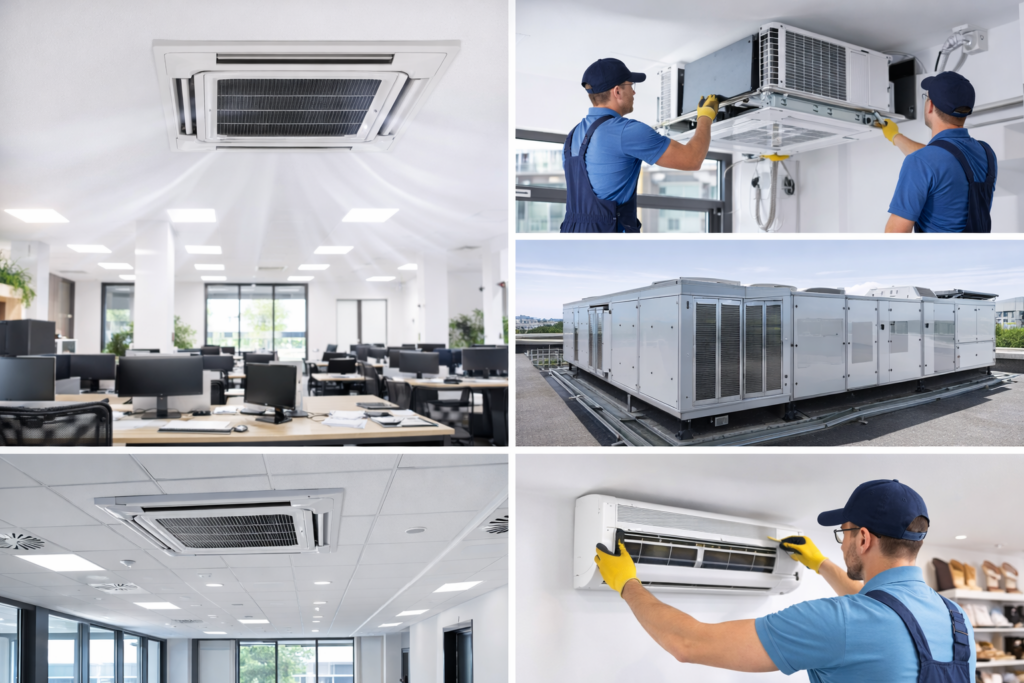
The primary concern for most businesses is disruption. A commercial air conditioning installation needs to be planned and executed to minimise downtime and interference with normal operations. For most light commercial and multi-split installations, work can be scheduled outside business hours or staged to keep key areas operational throughout. For larger, more complex installations, Varcoe’s team will discuss a realistic timeline and schedule upfront.
All electrical work is handled in-house. Varcoe’s Electrical team manages dedicated circuit installation, switchboard work, and any electrical upgrades needed, no subcontractors, no coordination between separate trades.
Once installed, the system is fully commissioned and tested before handover. Your team receives a walkthrough covering operation, zoning (if applicable), scheduling, and what to look out for in terms of basic maintenance. Every installation comes with Varcoe’s 12-month workmanship guarantee, and manufacturer warranties on units from Mitsubishi,Daikin, and Panasonic provide further coverage on the equipment itself.
Modern commercial air conditioning systems can be managed remotely, scheduled around business hours, and in some cases integrated with building management systems. This is increasingly relevant for Auckland businesses managing energy costs. Varcoe’s WiFi control systems allow remote operation from a smartphone useful for businesses where the first person in wants the space already at temperature, or where after-hours operation needs to be managed carefully. Discuss this with the team during the assessment stage if centralised or remote control is a priority.
Commercial systems work harder than residential ones, which means servicing matters more. A system that hasn’t been maintained runs less efficiently, draws more power, and is more likely to fail at the worst possible moment during a summer heatwave or a busy trading period. Varcoe recommends regular professional servicing for all commercial installations, handled by their Air Conditioning Servicing team across all Auckland suburbs.
Regular servicing covers filter cleaning, coil inspection, refrigerant level checks, electrical connection checks, and overall system performance testing. It extends the useful life of the equipment, keeps energy costs down, and keeps warranties valid. For businesses with multiple systems across a premises, a service agreement ensures everything is covered on a scheduled basis contact Varcoe directly to discuss what’s appropriate for your operation.
For a commercial installation, the installer’s experience with commercial environments specifically is worth verifying. Residential installers can fit a unit; commercial installations require knowledge of load calculations, zoning, commercial-grade equipment, and compliance with health and safety obligations in occupied workplaces.
Varcoe has been installing air conditioning across Auckland since 1975 commercial clients include offices, retail spaces, salons, restaurants, and industrial premises across the city. Over 12,000 systems installed across all sectors, with manufacturer-certified technicians on Mitsubishi, Daikin, and Panasonic equipment. The team covers North Shore, South Auckland, East Auckland, West Auckland, Manurewa, Papakura, and the Auckland CBD.
Light commercial systems suit smaller business premises, retail shops, offices, salons, and similar spaces where capacity requirements are moderate and installation is relatively straightforward. Industrial air conditioning covers larger, higher-demand environments such as warehouses, manufacturing facilities, and large-scale commercial or hospitality venues, which require more powerful systems, more complex design, and greater installation expertise. Varcoe handles both the light commercial and industrial air conditioning pages for more detail.
Yes. For most light commercial and multi-split installations, Varcoe can schedule work outside trading hours early morning, evening, or weekends to minimise disruption to staff and customers. For larger, more complex installations, work may need to be staged across multiple visits. This is discussed and agreed upfront before any work begins.
Commercial systems operate for longer hours under greater load than residential units, so more frequent servicing is advisable. As a general guide, professional servicing at least once a year is recommended, with higher-use environments benefiting from more regular attention. Varcoe’s Air Conditioning Servicing team services all makes and models across Auckland contact them to discuss a schedule suited to your premises.
In most standard commercial tenancy situations, you’ll need to notify your landlord and may need their written consent before any building works are undertaken; this is typically a lease requirement rather than a building consent issue. More significant installations, particularly those involving structural changes or ducting, may require building consent. Varcoe will advise on what’s applicable to your specific situation during the site assessment.
Varcoe installs Mitsubishi Electric, Daikin, and Panasonic for commercial applications all as manufacturer-certified installations, which ensures warranties are fully protected. All three brands offer commercial-grade equipment suited to the demands of business environments. The right brand and model for your premises will be recommended based on the site assessment and your specific requirements.
Whether you’re fitting out a new premises, replacing an ageing system, or expanding into additional space, Varcoe’s commercial team will assess your requirements, recommend the right system, and install it with minimal disruption to your business.
Request a free commercial site assessment →
Call the team directly: 0800 088 888 Monday to Friday, 8am–5pm.
Information in this article is based on Varcoe’s commercial services as of 2026 and is intended as a general guide. Requirements vary by premises type, tenancy, and system complexity contact Varcoe directly at varcoe.co.nz for advice specific to your business.