There are few things more frustrating than finding your air con not cooling on a hot Auckland day, leaving you with nothing but warm, stale air in return. Before you assume the worst, it is worth knowing that most cooling problems have straightforward causes. Many can be resolved without a technician visit. Others point to an underlying issue that needs attention before it turns into a costly repair.
This article walks you through the most common reasons your air conditioning unit is failing to cool properly and explains exactly what to check first.
When your system stops cooling, the very first things to check are the ones that are easiest to overlook.
The mode setting on your remote. It sounds obvious, but heat pump remotes are easy to accidentally switch from Cool to Heat or Fan-only mode. Look for the snowflake symbol for cooling and make sure the set temperature is actually lower than the current room temperature. If the room is already at 22°C and you have set the unit to 23°C, the system has no reason to run the compressor.
The fan speed and airflow direction. If the fan is set too low or the louvres are pointing straight up at the ceiling, cool air may be recirculating within the unit instead of reaching the occupied areas of the room. Set the fan to Auto or High and angle the louvres downward so cooled air washes across the room properly.
Whether the outdoor unit is actually running. Go outside and check that the outdoor condenser unit is spinning. If the indoor unit is blowing air but the outdoor unit is silent and stationary, the compressor has either tripped out or is not receiving power. This requires a technician.
Air filters sit inside the indoor unit and capture dust, pet hair, and airborne particles before they reach the coil. Over time they become clogged, which restricts airflow severely. When airflow drops, the evaporator coil cannot absorb heat from the room effectively, and cooling performance drops with it.
Cleaning the filters is a straightforward job you can do yourself. Open the front panel of the indoor unit, slide out the mesh filters, and wash them under warm running water. Let them dry completely before reinstalling. Most Auckland homes should be doing this every four to six weeks during periods of heavy use.
If your unit has not been cleaned in a year or more, a full heat pump and air conditioning service is the right call. A professional clean goes deeper than filter washing and includes the coil, drain tray, and fan blower, all of which accumulate grime that affects performance.
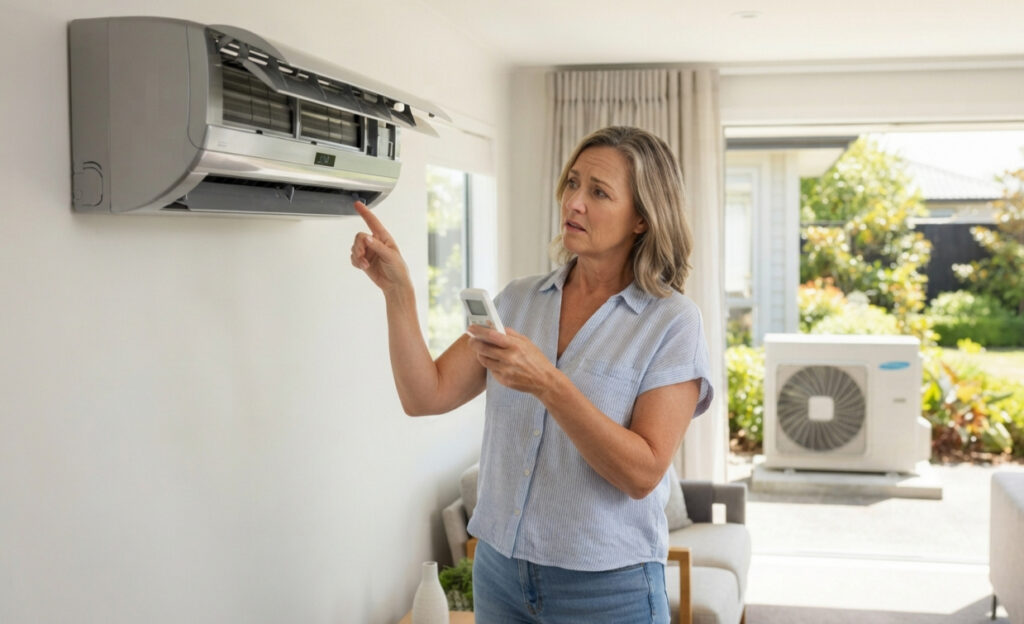
A system that is too small for the room it is trying to cool will run constantly without ever bringing the temperature down to the set point. This is particularly common when people move a portable or small wall unit into a much larger open-plan living area, or when a new extension or renovation has effectively increased the room size without upgrading the unit.
Sizing is calculated based on room dimensions, ceiling height, insulation quality, window area, and the orientation of the room relative to the sun. Auckland homes with large north-facing windows or open-plan layouts that connect kitchen, dining, and living areas require more capacity than a room’s floor area alone might suggest.
If your unit is simply too small for the job, no amount of servicing will fix the problem. Use the heat pump size calculator to get a quick sense of what capacity your room actually needs, then speak with a specialist about whether your current unit is fit for purpose.
Refrigerant is the substance that circulates between the indoor and outdoor units, absorbing heat from indoor air and releasing it outside. When there is a leak in the system, the refrigerant level drops and the unit loses its ability to transfer heat effectively.
Signs of a refrigerant issue include a unit that runs continuously but only produces mildly cool air, ice forming on the indoor unit or copper pipes, a hissing or bubbling sound from the piping, and the system taking far longer than usual to cool the room on mild days.
Refrigerant top-ups are not a permanent fix on their own. If the level is low, there is a leak somewhere in the system that needs to be found and repaired first. Handling refrigerant requires EPA licensing, so this is not a DIY job. Contact the Varcoe servicing team for a diagnosis.
The outdoor condenser unit needs clear airflow on all sides to release heat effectively. If it is boxed in by a fence, garden debris, overgrown shrubs, or a cover that has been left on during operation, the unit cannot shed heat and cooling efficiency falls sharply.
Check that nothing is within 300mm of any side of the outdoor unit and that the fins on the unit are clear of dust and leaf litter. Do not clean the fins with a high-pressure hose as this can bend and damage them. A gentle rinse with a garden hose is fine.
Direct afternoon sun beating onto the outdoor unit on very hot days can also cause the compressor to work harder than it should. A simple shade structure installed above the unit, without restricting airflow, can reduce the strain.
If you have worked through the checks above and the unit is still not cooling adequately, the problem is likely an internal one that requires qualified diagnosis. Common repair-level issues include a faulty thermistor, a failed capacitor on the compressor, a dirty or blocked condenser coil on the outdoor unit, or a control board fault.
For emergency repairs when the system has stopped working entirely during a heatwave, Varcoe offers priority call-outs across Auckland. For non-urgent performance issues, scheduling an annual heat pump service plan is the most cost-effective way to keep your system running at peak efficiency year-round and catch small problems before they become expensive ones.
Air conditioning and heat pump systems typically have a reliable service life of 12 to 15 years when properly maintained. If your unit is approaching or past that age and is showing persistent performance issues, the cost of ongoing repairs can start to outweigh the benefit of keeping the old system running.
Newer units from brands like Mitsubishi and Daikin are significantly more energy efficient than models from even ten years ago. A replacement often pays for itself through lower power bills within a few years, particularly if the old unit was also the wrong size for the space.
If you are considering upgrading, the team at Varcoe can assess your home and recommend the right solution. Options range from single-room units through to ducted whole-home systems that deliver consistent temperatures in every room without visible wall units.
The most likely causes are a clogged filter restricting airflow, the unit being set to Fan-only or Heat mode instead of Cool, or a low refrigerant level. Check the mode setting and clean the filters first. If the problem persists after doing both, book a service inspection.
No. Handling refrigerants requires EPA certification in New Zealand. Attempting to top up refrigerant without the correct equipment and licensing is both unsafe and illegal. A licensed technician will also locate and repair the leak before recharging the system, which prevents the problem from recurring.
A professional service once a year is the recommended minimum for residential units used regularly. Homes with pets, dusty environments, or units running year-round may benefit from servicing every six months. Filter cleaning by the homeowner every four to six weeks keeps performance up between professional services.
This usually points to one of three things: the unit is undersized for the room, the refrigerant level is low due to a leak, or the outdoor coil is heavily fouled and cannot shed heat effectively. All three require a technician to diagnose and fix correctly.
If the unit is more than ten years old, requires a major repair such as a compressor replacement, or has been performing poorly despite regular servicing, replacement is often the better investment. A new high-efficiency unit will cost less to run and comes with a fresh warranty, whereas an aging unit may need further repairs within a short period.
Whether your system needs a filter clean, a refrigerant recharge, an emergency repair, or a full replacement, the Varcoe team has been solving Auckland cooling problems since 1975. Our licensed technicians service all major brands across every Auckland suburb from North Shore to South Auckland.
Book your air conditioning service with Varcoe and get your system back to full performance before the next hot day hits. Call us free on 0800 088 888, or check out our latest heat pump and air con specials for current pricing on new installations.